



.png?width=250&name=OrderEase%20logo%2c%20Square%20(2).png)

On this page
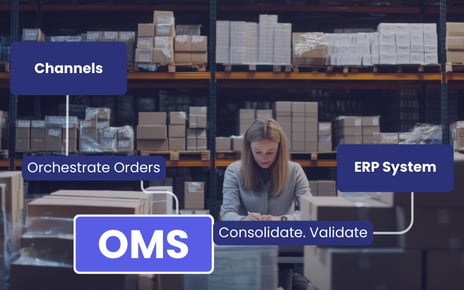
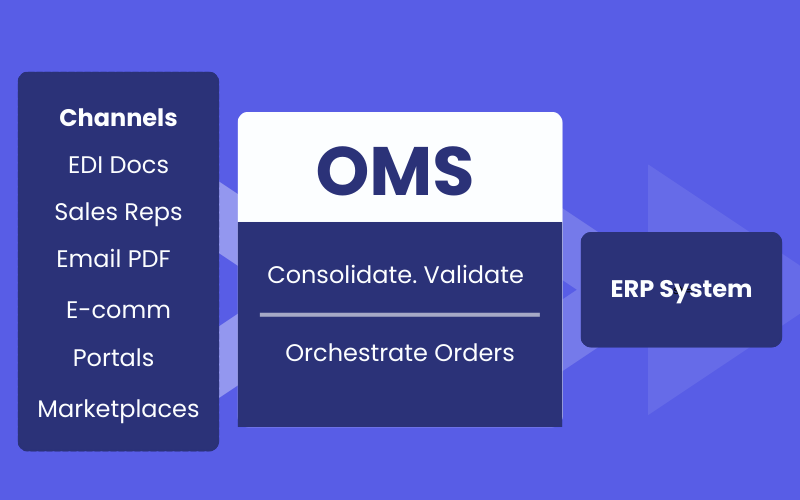
An Order Management System (OMS) is the operational layer that manages orders as they move through the business before becoming financial records. It receives orders from all channels, applies business rules, handles changes and exceptions, and orchestrates fulfillment. The OMS then passes clean, ready-to-process orders into the ERP. In this model, the ERP remains the system of record for accounting and inventory, while the OMS serves as the system of action that absorbs complexity, keeping the ERP stable, accurate, and scalable.
As organizations grow, orders stop behaving like simple transactions. They arrive from more channels, change more frequently, and carry more downstream consequences. Pricing becomes conditional. Fulfillment becomes fragmented. Exceptions become normal. Yet many businesses still expect their ERP system to absorb all of this complexity without friction.
At first, that approach seems reasonable. The ERP already exists, and adding another system feels unnecessary. Over time, however, cracks in the manual workflow begin to show. Manual work increases. Exceptions pile up. Customizations multiply. Teams spend more time fixing orders than fulfilling them.
This is where the distinction between order management software and ERP becomes critical.
ERP systems are essential to order operations as the financial backbone of the business, but they were never designed to manage the full lifecycle of modern orders. That role belongs to a true Order Management System that sits between your sales channels and your ERP, absorbing complexity so your core systems don’t have to.
Why OMS vs ERP Are Often Confused
The confusion around order management software isn’t accidental. It’s the result of how the category has been marketed for years.
This confusion is evident in buyer research, where platforms like G2’s Order Management Software category group ERP modules, inventory tools, accounting systems, and OMS platforms together.
Most buyers first encounter “order management” as a feature inside an ERP, CRM, or commerce platform. In that context, order management is framed as a set of capabilities: order entry, inventory allocation, and fulfillment tracking. It sounds like a natural extension of the systems businesses already own.
That framing worked when order flows were relatively simple. When businesses sold through one or two channels, with pricing static and fulfillment following predictable paths, ERP-based order handling was sufficient.
That world no longer exists.
Today’s orders arrive from sales reps, B2B eCommerce sites, EDI connections, marketplaces, customer portals, spreadsheets, and email. They all arrive with different pricing structures and exceptions.
The mistake many organizations make is assuming that because ERP can store orders, it should also manage them.
Those are fundamentally different responsibilities.
What Order Management Software Actually Does
To understand the difference between order management software and ERP, it helps to start with intent. Analyst research from Gartner on Enterprise Resource Planning (ERP) shows that ERP platforms are designed first for financial control and operational support, not as an engine for order orchestration.
Order management software exists to manage uncertainty. It assumes that orders will change, that exceptions will occur, and that different channels will behave differently. Instead of treating an order as a static record, a true OMS treats it as a process that evolves over time.
As the Gartner IT Glossary on Order Management explains, order management itself is a business process that spans systems, reinforcing why standalone orchestration layers are often required upstream of ERP.
A modern OMS receives orders from multiple sources, normalizes them into a consistent structure, applies business rules, orchestrates fulfillment, and maintains visibility as orders move through their lifecycle. Only once an order is valid, complete, and ready does it flow into the ERP.
That separation of responsibilities is what enables scale.
The Core Responsibilities of a Modern OMS
While order management platforms vary in depth, their responsibilities are consistent.
Order Intake
Whether an order comes from a sales rep, an online portal, an EDI transaction, or a spreadsheet upload, the OMS standardizes that input into a unified format. This alone eliminates a significant source of manual work.
Order Rules and Validation
OMSes apply business logic before the order reaches ERP. Pricing validation, customer eligibility, contract terms, minimums, credit rules, and availability checks all happen upstream. Errors are caught early, when they are easier and cheaper to fix.
Fulfillment Coordination
Order management systems coordinate fulfillment. They determine how orders should be routed, split, or staged based on inventory, location, and customer requirements. Changes are handled deliberately rather than patched together through emails and workarounds.
Order Visibility
Instead of forcing teams to navigate ERP screens designed for accountants, order management software offers real-time order status, exception tracking, and a shared operational view of what’s happening now.
This is where order tracking software and order status visibility actually belong.
What ERP Systems Are Designed to Do
ERP systems play a vital role in modern businesses, but that role is often misunderstood. Analyst firms like Gartner consistently frame ERP as a system of record, emphasizing stability, governance, and financial integrity over the flexibility required for real-time operational orchestration.
At their core, ERPs are systems of record. They exist to maintain financial accuracy, enforce data integrity, and support compliance. These characteristics are strengths when ERP is used for accounting, reporting, and planning. They are liabilities when ERP is forced to manage dynamic operational processes.
Orders, particularly in B2B environments, are rarely static. Quantities change. Ship dates move. Pricing is negotiated. Partial shipments are common. Customers revise requirements after the fact. These realities clash with ERP’s expectation that data should be correct before it enters the system.
When ERP is asked to manage this fluidity, something has to give. Usually, that “something” is operational efficiency.
Why ERP-Centric Order Management Breaks Down at Scale
In the early stages of growth, ERP-based order management often appears to work. Teams rely on manual checks, tribal knowledge, and informal processes to handle exceptions. Problems are solved ad hoc, and the cost is absorbed quietly.
As order volume increases, these workarounds become permanent.
Operations teams spend their days correcting orders instead of processing them. Customer service becomes a buffer between broken workflows and frustrated customers. IT teams are pulled into constant requests for customization to handle edge cases that were never anticipated.
Over time, the ERP becomes increasingly fragile. Custom scripts and logic accumulate. Integrations become brittle. Upgrades are delayed. The system that was meant to provide stability becomes a source of risk.
This is not because ERP is inadequate. It’s because it’s being used for a role it wasn't designed for.
Order Management Software vs ERP: The Real Difference
The difference between order management software and ERP is not about feature checklists. It’s about where complexity lives.
ERP systems are optimized to record what has already happened. Order management systems are optimized to manage what is happening right now.
When ERP is used as the primary order management system, every exception becomes a disruption. Every change requires manual intervention. Every new channel introduces risk.
When a true OMS sits in front of ERP, exceptions are expected. Changes are handled deliberately. Orders enter the ERP cleanly, consistently, and with far fewer surprises.
The result is order architecture that can scale.
The Limits of ERP-Only Order Management
Sage is a useful example of why the distinction between ERP and order management software matters. While Sage offers order management where orders are captured, as order complexity increases, limitations arise because ERP platforms are not designed to behave like operational order engines.
Where ERP-Based Order Management Starts to Strain
In environments where ERPs such as NetSuite, Sage, or Microsoft Dynamics 365 serve as the primary order management system, teams often encounter friction in familiar places.
Orders arrive from multiple sources, sales reps, eCommerce, EDI, customer portals, but your ERP expects them to conform to a consistent structure before entry. That means validation, normalization, and exception handling happen outside the system, through manual processes or custom iPaaS integrations.
Over time, businesses compensate for system limitations, leading to layered processes, growing reliance on spreadsheets, and resource-heavy custom scripts. The ERP remains accurate, but it becomes increasingly rigid and difficult to adapt.
This is the natural outcome of asking a system of record to act like a system of action.
This is where OrderEase fundamentally changes the equation.
Instead of forcing an ERP like Sage to absorb every variation, exception, and channel-specific nuance, OrderEase sits in front of the ERP as a true order management layer. Orders flow into OrderEase first, regardless of source. They are standardized, validated, and orchestrated before they ever reach Sage.
When OrderEase is layered on top of Sage, the ERP stops being a choke point and starts behaving like the engine it was meant to be.
.png?width=800&height=500&name=When%20Order%20Volume%20Outpaces%20Operational%20Capacity%20(1).png)
The Hidden Costs of Using ERP as Your Order Management System
Many organizations underestimate the cost of ERP-centric order management; manual effort increases incrementally, so it doesn’t trigger alarms. Over time, inefficiency becomes the baseline that hinders growth.
The real cost shows up in slower order cycles, higher error rates, employee burnout, and missed opportunities. Adding a new sales channel or fulfillment partner becomes a major initiative rather than a configuration change.
At that point, the business is no longer constrained by demand. It’s constrained by its systems.
Most Order Management Systems Are Built for Retailers, Not Suppliers
One of the least discussed reasons suppliers struggle with order management software is that most true OMS platforms were never designed for them in the first place.
Historically, Order Management Systems emerged in retail environments. Their primary purpose was to help retailers manage consumer orders across stores, warehouses, and online channels. The core problems they were built to solve revolved around inventory allocation, last-mile fulfillment, returns, and customer experience at scale.
This retailer-first framing is reflected in analyst coverage, where Forrester frequently positions OMS within commerce and retail fulfillment contexts rather than upstream supplier operations.
For retailers, the order is the end of the story.
For suppliers, it’s the beginning.
Distributed OMS Design Misses Supplier Reality
Retail-centric OMS platforms, including many Distributed Order Management Systems (DOMS), assume a level of control suppliers rarely have.
These systems are optimized for environments where pricing is standardized, inventory is owned or centrally visible, fulfillment paths are predictable, and the organization controls the customer relationship end-to-end. Orders are treated as fixed transactions that need to be intelligently routed downstream toward shipment and delivery.
That model works well for retailers operating complex fulfillment networks.
It breaks down for suppliers.
Suppliers operate upstream, where orders are inherently variable. Orders arrive from retailers, distributors, buying groups, sales reps, portals, EDI connections, and spreadsheets, all with conflicting requirements. Pricing is negotiated. Pack sizes vary. Ship dates shift. Partial fulfillment is normal. Compliance rules differ by customer.
Distributed OMS platforms struggle here because they are designed to optimize fulfillment after an order is already clean. They expect consistency at intake. When suppliers attempt to force their workflows into these systems, the result is extensive customization, brittle logic, or manual work layered on top.
In practice, the OMS becomes another constraint instead of a solution.
Distributed OMS platforms, while powerful for routing inventory across locations, are still downstream-oriented. They excel at deciding where to fulfill an order, not at managing the messy, negotiated, and exception-driven reality of how supplier orders are created in the first place.
Why This Pushes Suppliers Back Into ERP
When OMS platforms fail to reflect how suppliers actually sell, teams default to the one system they can bend to fit reality: the ERP.
ERP systems are not ideal for managing order complexity, but they are flexible in ways retail-centric OMS platforms often aren’t. Suppliers can customize fields, extend workflows, and implement customer-specific rules directly in the ERP, even at the cost of efficiency, visibility, and long-term maintainability.
As a result, many suppliers use ERP as their de facto order management system, not because it works well, but because it’s the only system they fully control.
Over time, this creates a familiar pattern. The ERP becomes overloaded with logic it was never designed to handle. Manual processes proliferate. Order visibility declines. Scaling becomes painful.
The root cause isn’t a lack of OMS investment but the lack of a supplier-first OMS that understands upstream order reality.
Why a Supplier-First OMS Changes the Equation
A supplier-first Order Management System changes the equation by restructuring where order logic lives in the architecture.
Instead of treating the ERP as the point at which order decisions are made, a supplier-first OMS introduces a dedicated operational layer that handles order intake, transformation, validation, and state management before financial commitment.

Order Intake as a Normalization Layer
In supplier environments, orders enter the business in fundamentally different formats. EDI documents, sales-rep orders, portal submissions, eCommerce checkouts, spreadsheets, and email-based orders all carry different structures, assumptions, and degrees of completeness.
A supplier-first OMS ingests these inputs into a canonical order model. Line items, pricing, units of measure, ship-to rules, and customer identifiers are standardized at intake rather than forced into ERP-specific formats. This eliminates the need for per-channel ERP mappings and prevents malformed orders from entering the core system.
At this stage, the OMS acts as a translation and consolidation engine, not a financial system.
Rule-Driven Validation Before ERP Commitment
Once orders are normalized, a supplier-first OMS applies pre-ERP validation logic.
This includes pricing enforcement against customer agreements, minimums and pack constraints, eligibility checks, inventory availability rules, credit status validation, and customer-specific fulfillment requirements. Crucially, these rules are evaluated before the order becomes a financial transaction.
If an order fails validation, it is held in an actionable state within the OMS rather than rejected downstream or manually corrected inside ERP. This prevents rework, preserves data integrity, and keeps accounting systems insulated from incomplete or non-compliant orders.
Order State Management and Change Control
Supplier orders rarely remain static. Quantities change, ship dates move, items are substituted, and partial fulfillment becomes necessary.
A supplier-first OMS manages these changes explicitly through order state transitions rather than overwriting records. Revisions are tracked, dependencies are respected, and downstream systems are deliberately updated instead of reacting to them.
ERP systems are updated only when an order is deemed stable enough to post. This avoids the common ERP failure mode where accounting records are repeatedly adjusted to reflect operational churn.
Controlled Release to ERP
Only after an order passes validation and reaches a defined operational state does it move into ERP.
At that point, the OMS hands off a clean, complete, ERP-aligned transaction. The ERP remains responsible for accounting, inventory valuation, invoicing, and reporting, but it no longer requires team members to input data.
This separation allows ERP to operate as designed: deterministic, auditable, and stable.
Why This Architecture Matters
From a systems perspective, a supplier-first OMS establishes clear ownership boundaries:
-
The OMS owns order variability, rules, and lifecycle state
-
The ERP owns financial truth and inventory accounting
This prevents order complexity from accumulating inside ERP customizations and brittle integrations. New channels can be added without redesigning core systems. Business rules can evolve without refactoring financial workflows. Order volume can increase without scaling manual effort.
The result is an order architecture that reflects how suppliers actually operate: upstream complexity managed operationally, downstream systems kept clean and resilient.
That is the real distinction—not philosophy, but system responsibility.
How a True OMS Improves ROI Without Replacing ERP
The ROI of order management software is often misunderstood as simple labor savings. In reality, the largest gains come from structural leverage.
By handling validation, orchestration, and exception management upstream, a true OMS reduces the operational noise that clogs ERP workflows. Orders enter the ERP cleaner and more consistently, reducing rework and downstream errors.
This lowers the long-term cost of ownership for ERP by minimizing customizations and simplifying integrations. It also accelerates order processing, improves fulfillment accuracy, and enables teams to focus on higher-value work.
Most importantly, it allows the business to grow without repeatedly re-architecting its financial backbone.
When Businesses Outgrow ERP-Only Order Management
Most businesses don’t consciously decide to outgrow ERP-only order management. They experience it as friction; slowly at first, then all at once.
The signals are operational, not theoretical, and they tend to appear in a predictable pattern.
Signal #1: Channel Sprawl Becomes the Norm
The first breaking point is almost always channel expansion.
Orders begin arriving through sales reps, customer portals, EDI connections, eCommerce sites, spreadsheets, and email. Each source introduces its own structure, assumptions, and exceptions. ERP expects those differences to be resolved before entry, which pushes normalization work onto people and processes outside the system.
At this stage, ERP is no longer managing orders. It’s acting as a reconciliation point for inconsistencies created upstream.
Signal #2: Exceptions Become the Default Workflow
As order volume grows, exceptions stop being edge cases.
Pricing discrepancies, incomplete orders, availability conflicts, ship-date changes, and partial fulfillment requests become routine. When a meaningful percentage of orders require manual review or correction before they can move forward, the system is no longer enabling scale; it’s shifting operational responsibility onto humans.
Teams spend more time interpreting orders than processing them. Throughput becomes dependent on headcount rather than on system capacity.
Signal #3: Growth Introduces Disproportionate Friction
The clearest signal appears during growth.
Adding new customers, products, pricing models, or fulfillment partners should increase revenue. When each expansion instead requires ERP customization, new integrations, or process redesign, it’s a sign the architecture is misaligned with how the business operates.
Growth starts to feel heavy. Changes take longer. Risk increases. The ERP becomes harder to modify without unintended consequences.
What These Signals Actually Mean
None of these symptoms points to a failure of ERP.
They point to the absence of a dedicated order management layer.
ERP systems enforce structure and protect financial integrity. The problem is that upstream order complexity has nowhere else to go.
A true Order Management System takes ownership of that complexity before orders reach ERP. It normalizes inputs, manages exceptions, and controls change so ERP can remain stable, accurate, and scalable.
That’s the moment businesses don’t just outgrow ERP-only order management, they outgrow the architecture itself.
Why a Supplier-First Order Management System Outperforms ERP-Only Approaches
The advantages of a supplier-first Order Management System are evident in the day-to-day realities of how teams work, how orders move, and how reliably customers receive them.
When order management is handled inside ERP, accuracy depends on manual intervention, and scale introduces friction. A true OMS changes how orders flow before they ever become financial records.
The difference is most visible in four critical areas:
Real-Time Visibility Without ERP Friction
ERPs were built to record outcomes, but order visibility within ERPs is often delayed and obscured behind accounting-centric screens. A true OMS provides visibility where operations teams actually need it: in real time, across the full order lifecycle.
Because all orders flow through the OMS regardless of channel, it becomes the source of truth. Teams can see which orders are pending, waiting on inventory, split for fulfillment, or requiring attention due to exceptions.
Teams can see what’s happening now and why.
The result is faster issue resolution and a shared understanding of order status across sales, customer service, and operations.
Team Efficiency That Scales With Volume
When your company’s ERP is used as the primary order management system, efficiency is capped by manual workflows across multiple departments. Every exception requires human intervention. Every new channel requires IT configuration. As volume grows, teams work harder just to keep up.
With an OMS, orders are automatically validated, channel-specific rules are handled, and exceptions are flagged immediately rather than discovered reactively.
This allows operations teams to shift from constant firefighting to structured oversight. The outcome isn’t just faster processing, it's a headcount that no longer needs to scale with order volume.
More Accurate Order Fulfillment by Design
Fulfillment depends on clean orders.
When orders enter ERP with missing data, incorrect pricing, or unresolved conditions, errors continue downstream.
-
Warehouses ship the wrong quantities.
-
Partial shipments aren’t coordinated properly.
-
Returns increase.
-
Customer trust erodes.
A true OMS prevents these issues by enforcing accuracy before fulfillment even begins; orders are checked against availability, pricing rules, customer agreements, and fulfillment constraints before they are released.
Because the ERP receives orders that are already validated and structured, fulfillment systems can operate with confidence. Accuracy improves not because teams are more careful, but because the system is designed to prevent mistakes.
Scalability Without Re-Architecting ERP
Order management that’s handled by your company’s ERP scales poorly because every new requirement pushes complexity deeper into the core system. New channels require new integrations. New pricing models require customization. New fulfillment partners introduce fragile logic.
Eventually, growth slows because existing systems can’t support it.
With an OMS, new order sources can be added without touching ERP logic. This makes growth additive instead of disruptive, with the ERP remaining stable while the OMS absorbs change.
The Features That Make a True OMS Different
The benefits of an OMS come from architectural intent. That said, several capabilities consistently distinguish true order management systems from ERP-native approaches.
A modern OMS provides centralized, channel-agnostic order intake, ensuring all orders follow the same operational path regardless of origin. It includes configurable business rules that can adapt as pricing, partners, and policies evolve. Most importantly, it integrates deeply with the ERP while remaining independent, allowing each system to do what it does best.
The Most Commonly Mistaken “OMS” Tools
As order complexity grows, many businesses realize they need something beyond basic order entry. The challenge is that the market is full of tools that touch orders but don't function as a true Order Management System.
These solutions often play an important role in the order ecosystem, but they aren’t designed to manage the full order lifecycle. Understanding where they fit (and where they fall short) helps clarify why a true OMS exists in the first place.
ERPs With Order Portals or Lightweight Integrations
Platforms like Sage and Microsoft Dynamics 365 are often mistaken for full OMS solutions because they include order portals, extensions, and app marketplaces that expand native capabilities.
These ERP ecosystems can absolutely support order intake and basic workflows. With the right configuration, teams can accept orders from customers, sales reps, or connected systems and route them into core financial processes. For organizations already invested in these ERPs, this feels like a logical path forward.
The confusion begins with the assumption that these capabilities amount to a true OMS.
ERP-based order tools still expect orders to conform to ERP structures early in the process. Normalization, exception handling, and orchestration often happen through a mix of customizations, add-ons, and manual processes. While the app marketplaces and connectors do a solid job of filling functional gaps, they rarely create a unified, channel-agnostic order lifecycle.
There’s also a practical reality to consider. Initial setup is rarely plug-and-play. Standards, extensions, and environments take time to configure, and teams without prior experience often feel the ramp. G2 reviewers frequently note that while the ecosystem is powerful, it requires careful implementation and ongoing management to work smoothly.
ERP platforms like Sage and Dynamics are excellent systems of record with extensibility, but they are not designed to be dedicated order engines. They benefit significantly from a true OMS layered in front of them.
Accounting Systems (e.g., QuickBooks Online)
Accounting platforms are another common stopgap in order management.
QuickBooks Online, for example, is widely used as a financial hub for growing businesses. It handles invoicing, payments, and basic inventory tracking well enough for early-stage operations. Because it sits at the center of finance, many teams naturally push order activity into it as well.
The limitation is that accounting systems are not built for operational order management.
QuickBooks lacks the tools to manage purchase orders, complex sales orders, fulfillment workflows, and exception handling. There’s little support for multi-channel orchestration or order lifecycle visibility. As order volume and complexity increase, teams quickly outgrow what accounting software can reasonably support.
That’s why many businesses pair QuickBooks with a lightweight OMS (order management system). The accounting system remains the financial source of truth, while the OMS handles the operational reality that QuickBooks was never designed for.
CRM Platforms Positioned as Order Management (e.g., Salesforce)
Salesforce’s positioning in the order management space often causes confusion.
Salesforce Order Management is not a standalone OMS in the traditional sense. It is an extension of a much larger CRM and commerce ecosystem, designed primarily to serve Salesforce’s existing customer base.
Within that context, it can be effective for enterprises already deeply invested in Salesforce Commerce Cloud and CRM workflows. Orders are treated as part of a broader customer engagement model, tied closely to marketing, service, and sales data.
However, this approach has limitations.
Order management is not Salesforce’s core function. It is a vertical product layered on top of a CRM-first architecture. For organizations not already standardized on Salesforce, adopting it purely for order management is rarely practical. The cost, complexity, and implementation effort tend to outweigh the benefits if the CRM is not already central to the business.
Salesforce’s OMS capabilities make sense inside the Salesforce universe. Outside of it, they are often more than what teams need—and less than what a true OMS provides.
Document Automation and Order-to-Cash Platforms (e.g., Esker)
Platforms like Esker typically enter the conversation through order-to-cash automation rather than order management itself.
Esker focuses on digitizing documents, automating data capture, and improving downstream financial processes. It plays a valuable role in reducing manual entry and accelerating invoicing and accounts receivable workflows.
What it does not provide is holistic order lifecycle management.
These tools excel at processing documents once they exist, but they do not orchestrate orders across channels, manage fulfillment complexity, or act as a central operational control layer. They are complementary technologies, not replacements for an OMS.
In many environments, Esker-style platforms work best alongside an OMS, handling documentation and financial workflows while the OMS manages order flow and exceptions upstream.
Online Form Builders (e.g., Jotform)
Online form builders are sometimes labeled as “order management software” simply because they can collect order data.
Tools like Jotform make it easy to create order forms and capture customer or internal team inputs. For simple use cases, this can be a fast way to digitize order intake.
But form builders stop where order management begins.
They don’t normalize orders across channels, enforce business rules, coordinate fulfillment, or provide lifecycle visibility. They collect data, but they don’t manage it.
For growing businesses, form builders are often a temporary solution that eventually feeds into something more robust.
Inventory Management Software (e.g., Linnworks)
Inventory platforms like Linnworks are often mistaken for OMS because they sit close to fulfillment.
These systems excel at inventory synchronization, stock levels, and warehouse coordination in eCommerce-heavy environments. They ensure products are available and quantities stay accurate across channels.
What they don’t manage is the full order lifecycle.
Inventory systems focus on what is available, not how orders should be validated, changed, split, or resolved when exceptions arise. They are an important downstream component, but they depend on clean, well-orchestrated orders to function effectively.
That orchestration is the role of an OMS.
eCommerce Platforms (e.g., Shopify)
eCommerce platforms are another frequent source of confusion.
Shopify, for example, provides excellent tools for online order capture, basic fulfillment, and customer communication. For DTC businesses with simple workflows, it can serve as the primary order environment.
The limitation appears when e-commerce is no longer the only channel.
Once orders come from sales reps, EDI, marketplaces, or wholesale portals, Shopify’s order model becomes insufficient. It is optimized for web storefronts, not complex B2B order orchestration.
In multi-channel environments, Shopify works best as one order source feeding into a broader OMS, not as the system managing all order activity.
Why These Tools Are Still Integral to Order Management
None of these platforms is “wrong.” Each plays a valuable role in the broader order ecosystem.
The mistake is expecting any one of them to behave like a true Order Management System.
A modern OMS does not replace ERP, accounting, CRM, inventory, or commerce platforms. It connects them. It absorbs upstream variability, enforces consistency, and ensures that downstream systems receive clean, actionable orders.
That’s what turns a collection of systems into a coherent order engine.
And that’s why a true OMS exists at all.
How OrderEase Functions as a True Order Management System
OrderEase exists for one reason: to manage the reality of orders without forcing ERP systems to absorb complexity they were never designed to handle.
Rather than replacing ERP, accounting, inventory, or commerce platforms, OrderEase operates as the layer that connects them.OrderEase is not a coordination tool or middleware workaround. It is a purpose-built Order Management System designed to sit between how orders enter the business and how they are recorded financially.
A System of Action for Order Operations
At its core, OrderEase functions as a system of action.
All orders, regardless of source, flow into OrderEase first. Sales reps, customer portals, eCommerce sites, EDI connections, spreadsheets, and integrations all feed into a single operational layer. From there, orders are normalized into a consistent structure, validated against business rules, and prepared for fulfillment.
This allows OrderEase to manage what ERP cannot: change, exceptions, and variability.
Designed to Protect ERP, Not Complicate It
One of the most common failure points in order operations is overloading ERP with logic that doesn’t belong there.
OrderEase is designed to prevent that.
Instead of embedding channel-specific rules, pricing nuances, and fulfillment logic inside ERP, OrderEase handles these concerns upstream. The ERP receives clean, validated orders that align with its data model and accounting requirements.
This keeps ERP stable, upgradeable, and focused on what it does best: financial accuracy and system-wide reporting.
The result is not just better order processing—it’s a healthier long-term architecture.
Channel-Agnostic by Design
OrderEase does not assume a single sales motion.
Whether orders originate from B2B eCommerce, sales reps, EDI, marketplaces, or custom integrations, they are treated consistently. Each channel can retain its unique requirements without forcing downstream systems to accommodate them individually.
This channel-agnostic approach allows businesses to add new order sources without reworking their entire stack. Growth becomes additive instead of disruptive.
Operational Visibility Built for Real Teams
OrderEase is designed for the people who actually manage orders; operations teams gain a real-time view of orders, customer service can answer questions without escalating to finance, and sales teams can understand order impact without creating work for operations.
This shifts order management from reactive problem-solving to proactive control.
Flexible Without Being Fragile
With OrderEase, business rules can be adjusted as pricing models change, partners evolve, or new fulfillment strategies emerge—without rewriting core systems or introducing brittle logic. This allows teams to respond to market changes quickly while maintaining system integrity.
Instead of accumulating technical debt, OrderEase absorbs complexity in a controlled, maintainable way.
Built for B2B Order Reality
OrderEase is purpose-built for B2B environments, where orders are rarely simple.
It supports negotiated pricing, customer-specific rules, partial shipments, backorders, and multi-step fulfillment flows. It acknowledges that B2B orders are often collaborative, iterative, and exception-driven.
By modeling that reality directly, OrderEase enables scale without forcing businesses to oversimplify their sales processes.
The Role OrderEase Plays in a Modern Order Stack
In modern architecture, OrderEase does not compete with ERP systems, accounting systems, inventory platforms, or commerce tools. It connects them.
Orders flow from channels into OrderEase, where they are managed operationally. Clean, validated orders are then moved into the ERP for financial processing. Inventory and fulfillment systems receive accurate instructions. Reporting becomes more reliable because upstream noise has been removed.
This is what turns a collection of systems into a coherent order engine.
OrderEase doesn’t just automate orders—it makes them work.
Frequently Asked Questions About Order Management Software
What is the difference between order management software and ERP?
ERP systems record and account for orders. Order management software manages the order lifecycle—intake, validation, changes, and exceptions—before orders are finalized and recorded.
Can an ERP replace an order management system?
ERP can handle basic order entry, but it is not designed to manage multi-channel complexity or frequent order changes at scale.
Is order management software only for e-commerce businesses?
No. Order management systems support B2B sales reps, EDI transactions, customer portals, marketplaces, and traditional order flows.
How does order management software improve ROI?
By reducing manual work, preventing errors, protecting ERP systems from excessive customization, and enabling faster, more scalable operations.
Do small businesses need order management software?
Many small businesses start with ERP alone, but those with multiple channels or rapid growth often benefit from even simple OMS solutions.
What should businesses look for in an OMS?
Strong ERP integration, channel-agnostic order intake, configurable business rules, and real-time order visibility.
Conclusion: Order Management Is a Strategic Layer, Not an ERP Feature
ERP systems remain essential. They are the backbone of financial operations and reporting.
But they were never meant to manage the full complexity of modern order flows.
Order management software exists to handle change, exceptions, and growth without destabilizing core systems. When businesses separate order management from record keeping, they gain resilience, clarity, and room to scale.
If your ERP feels increasingly strained by orders, the issue isn’t your team or your process. It’s the role you’re asking your systems to play.
Schedule a demo with OrderEase to see how modern order management software can integrate with your ERP to support growth without added complexity.
Meet the author
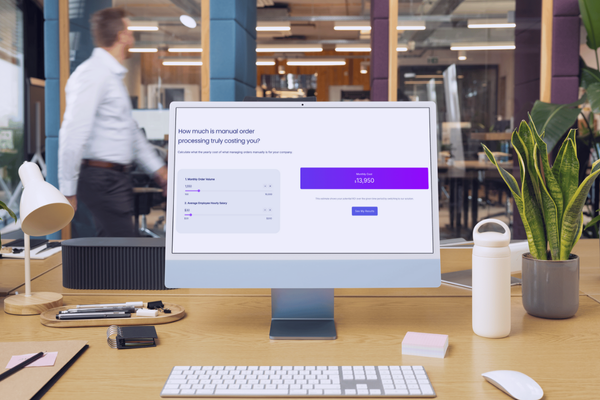
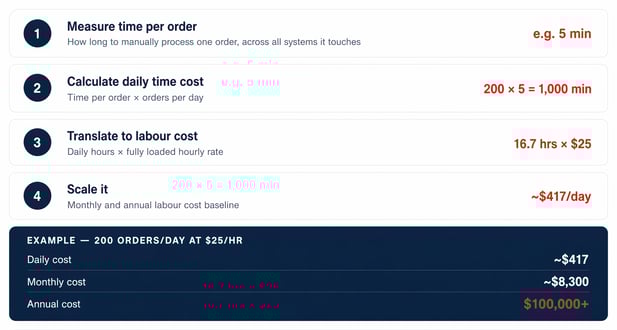
How much is manual order processing truly costing you?
Taking orders via email, jumping between portals and copy+pasting everything eats away at margins. See how much it's costing your business month-by-month.