




Skip to content
Order Management Comparisons

Compare B2B
order management software

Explore the differences between EDI software, iPaaS, B2B portals and unified order management. Understand the trade-offs and find the right approach for your order workflows.

Side by side

OrderEase vs. other B2B order solutions

See how different solutions handle B2B order processing.

Swipe to compare more

What you need it to do OrderEase EDI software iPaaS Standalone portals PDF and CSV capture apps ERP customizations Ecommerce and retail OMS
Orders in
Retailer EDI documents
Emailed PDF and CSV orders
Ecommerce and marketplace orders
Customer ordering portal
Native sales rep app
Checks
Runs every channel through the same checks
Checks items, pricing and accounts against your ERP and flags errors
Order rules included, no custom build
Connections
Preconfigured ERP integration —
Connects to systems outside its standard integrations
Explore by solution type

What do you run today?

Take a closer look at each approach to B2B order processing.

Works with your existing systems

Build on your existing systems
Improve order processing

Your customers may order through EDI networks, ecommerce platforms and other channels. OrderEase helps bring supported order workflows together without necessarily replacing the systems you already use.

Order sources

EDI networks
Ecommerce
Email & portals
OrderEaseOrder capture, validation and processing
ERP & fulfilment systems

Illustrative workflow. Integrations depend on supported configurations.

Browse integrations
Buyer’s checklist

Four questions to ask any vendor

Use these questions to evaluate your options.

  1. Which orders can it process?

    Check support for EDI, emailed PDFs, portals, ecommerce and other order sources you use.

  2. What happens when an order is wrong?

    Ask how SKU, pricing and quantity errors are detected, flagged and resolved.

  3. Who handles the integration work?

    Clarify who connects, tests and maintains your ERP and trading partner integrations.

  4. What is the total cost?

    Account for platform fees, setup, new trading partners, document volumes and ongoing support.

Customer Stories

See how OrderEase works in practice

Real examples of retailer EDI, wholesale ordering and ERP-connected workflows.

OrderEase gives us the automation to meet those expectations consistently while keeping our team focused on growing the business instead of managing paperwork.

Al Martins Director, Fence Armor
Read the Fence Armor story
20,200+
Home Depot and Lowe's EDI orders since 2022
processed by a team of 10, with no manual re-keying
Systems connected
  • Home Depot
  • Lowe's
  • ShipStation
  • QuickBooks
900+
hours saved per year
Orders from multiple sources moving into Microsoft Dynamics Great Plains
Read the story
100%
reduction in manual order entry
Wholesale order workflows at an Ontario beverage supplier
Read the story
90%
less paper orders
Wholesale order workflows at an Ontario beverage supplier
Read the story

FAQs

Is OrderEase an EDI provider, an order management system (OMS) or a middleware?
OrderEase is a B2B order management system that includes retailer EDI. It takes orders from every channel (EDI, emailed PDF and CSV POs, customer portals, sales reps and marketplaces), checks each one against your ERP’s item, pricing and account rules, and sends only valid orders into the ERP. EDI providers move documents and middleware moves data; OrderEase holds and validates the order itself. You can start with one channel and add the rest.
Does OrderEase replace EDI software like SPS Commerce or TrueCommerce?

It replaces the manual side of them. SPS Commerce and TrueCommerce run the networks your retailers use, and most suppliers we work with already connect to one of them, often through a web portal where orders are keyed by hand.

OrderEase automates that step, processing 850 purchase orders in and 856 ASNs out straight into your ERP, and runs the workflows the network doesn’t cover: emailed POs, portal and rep orders, validation, fulfillment and shipping. You do business with your retailers’ network more efficiently, in one system.

Do I have to change my retailer EDI connections to use OrderEase?

No. Your retailers’ network stays in place and they change nothing. You choose how you connect to it, and OrderEase makes that connection, so retailers receive the same documents and compliance they do today.

What changes is on your side: EDI orders land in the same validated queue as your emailed, portal and rep orders before they reach the ERP.

My ERP already has an EDI module or a PDF-to-sales-order app. Why would I add OrderEase?

If your only problem is emailed POs or one retailer’s EDI going into one ERP, the native module may be enough. A native app handles one channel into one ERP. OrderEase runs outside your ERP on purpose: it stops bad orders before they reach it, and it covers every channel (EDI, PDF, portal, reps, marketplaces) and every system orders touch (3PL, ecommerce, a second ERP) in one place. If you only need the PDF lane today, the Email Automation runs on its own, and the other channels switch on when you add them.

How is OrderEase different from iPaaS tools like Zapier, Make or Celigo?

Zapier, Make and Celigo move data between apps; the order rules are yours to build and maintain, and a bad order moves just as fast as a good one.

OrderEase comes with the B2B order logic in place, including tiered pricing, item validation, retailer requirements and exception handling, so operations teams run it without a developer.

If you only need to connect two systems, iPaaS is the cheaper tool. If orders need to be checked before they reach the ERP, iPaaS needs that logic built on top.

Can OrderEase replace Shopify for B2B wholesale ordering?

Yes for wholesale, and no for direct-to-consumer, which it isn’t meant to do.

OrderEase runs B2B wholesale ordering with account-specific pricing, order minimums, shipping schedules and workflows into your ERP, 3PL and shipping, the parts Shopify B2B needs a stack of apps to approximate.

For B2C, Shopify stays your storefront; OrderEase pushes your catalog up to it and brings those orders into the same checked flow as the rest.

Does OrderEase replace my ERP or customer portal?
No. Your ERP stays the system of record; OrderEase syncs customers, items, pricing and orders with NetSuite, Dynamics 365, Acumatica, Sage and QuickBooks rather than customizing them. An existing customer portal keeps running, with its orders checked alongside EDI and rep orders before posting. If you don’t have a customer or rep ordering app, OrderEase provides one.
What happens to an order that fails a check?
It stops before the ERP. OrderEase flags orders with an unknown item, off-contract pricing, a missing ship-to or an unmet retailer requirement and routes them to your team to fix or approve. Valid orders post automatically. This is the step that EDI networks, iPaaS, native ERP modules and portals leave to the ERP, or to a person, after the fact.
Who is OrderEase best suited for?

OrderEase is built for mid-size manufacturers, wholesalers and distributors that sell to retailers and run orders through more than one channel into an ERP, often with a 3PL or several trading partners in the mix. Suppliers usually start with the channel causing the most work, whether that is retailer EDI, emailed POs through Email Automation, a sales rep app or wholesale ordering, and add the rest as they grow.


What does manual order entry actually cost a supplier?
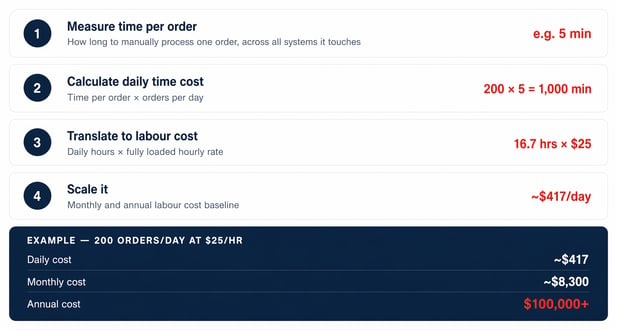
Usually more than the software that replaces it. One person re-keying POs costs their salary plus every error that reaches the ERP: wrong pricing, short-shipped lines, retailer chargebacks. Suppliers on this page report 900+ hours saved per year and manual order entry eliminated. Put your own order volume into the ROI calculator to see the number.

See how your orders would flow

Bring your order channels, ERP and current tools. We'll review where OrderEase can fit.

Book a demo