




.png?width=250&name=OrderEase%20logo%2c%20Square%20(2).png)

On this page
- EDI moves the order document. An ERP records the transaction. Deciding whether that order is commercially right belongs to neither of them
- Validation runs three layers deep: X12 syntax, then the retailer's own requirements, then price, SKU and customer terms. A clean EDI file only clears the first two
- The third layer is where real order errors live. Skip it and you find them in the ERP after posting, when unwinding costs far more than checking would have
EDI and ERP are not competing systems.
EDI is a standard for formatting and exchanging business documents between trading partners. An ERP is the system of record where a business keeps its financial and operational data. Most suppliers run both, and each one does a different job.
The question worth asking sits between them: what happens after an order arrives and before it posts to the ERP.
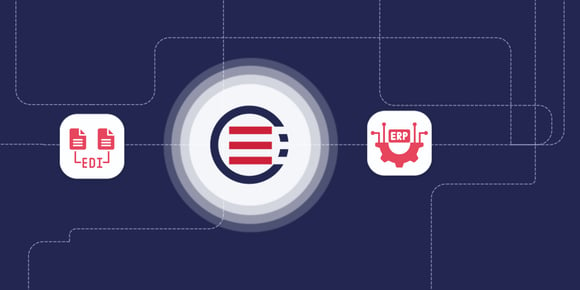
EDI can confirm a document is structured correctly. An ERP records the transaction once it's real. Whether the order is commercially right, at the right price, for a customer entitled to those terms, is a third job that belongs to neither. That gap is where most supplier order problems start.
EDI vs ERP at a glance
|
Question |
EDI |
ERP |
|---|---|---|
|
What is it |
A standard for formatting and exchanging documents between trading partners |
A system of record for financial and operational data |
|
What it governs |
Document structure and transport: the 850 purchase order, 855 acknowledgement, 856 ship notice, 810 invoice, 997 functional acknowledgement |
Inventory, accounting, fulfillment, customer accounts |
|
What it confirms |
Whether the document is structurally valid and meets the partner's format |
Nothing on arrival. It records what it's given |
|
What it's built for |
Two systems reading the same document the same way |
Accuracy and auditability once a transaction is real |
|
Where it struggles |
Judging whether an order is commercially right |
Interpreting inconsistent inbound orders before they post |
Where each system's responsibility starts and ends is the subject of our comparison of OMS and ERP for suppliers.
Why EDI vs ERP is the wrong question for most suppliers
Both systems do their jobs well. The problem is what neither one owns.
EDI software products vary widely. Some transmit and translate documents. Others add trading-partner rules, exception handling, and validation on top. So asking whether a platform "does EDI" tells you very little. What matters is what it checks before an order moves downstream.
The standard itself is explicit about that boundary. The 855 purchase order acknowledgement, the document that tells a retailer whether you accept their order, is described by X12 as "reporting back from the seller's purchase order system after the 850 Purchase Order data has been processed." The commercial decision comes from your own order system. EDI carries the answer, it doesn't produce it.
The 3 layers of EDI order validation
Order validation is really three separate questions, and a system can answer the first two well while never touching the third.
|
Validation layer |
What it Asks |
|---|---|
|
What it is |
Is the document structurally valid? |
|
What does it govern? |
Does it meet this retailer's requirements? |
|
What does it confirm on receipt? |
Is this a valid order for our business? |
Syntax validation checks the X12 structure: required segments, valid codes, a properly formed envelope. This is what a 997 functional acknowledgement reports, and X12's own documentation is direct about its scope. A 997 conveys "the results of the syntactical analysis of the electronically encoded documents," and the standard "does not cover the semantic meaning of the information encoded in the transaction sets."
Trading-partner validation checks a specific retailer's implementation requirements: required fields, approved codes, timing windows. This is where a retailer's own compliance terms apply, and where failures can turn into chargebacks.
Business validation asks whether the order makes sense commercially:
- Is this the contracted price for this customer?
- Does the customer's SKU map to a real internal product?
- Is the unit of measure valid?
- Is the account entitled to those terms?
- Can you fill the quantity?
An order can clear the first two layers cleanly and still fail the third. That's where most supplier order errors come from, and it's the layer neither the EDI standard nor the ERP was designed to own.
What this looks like on a real order
An EDI 850 arrives from a retailer:
- Customer SKU: HD-4821
- Quantity: 96
- Unit price: $18.50
The document can be structurally valid and fully compliant with that retailer's EDI requirements. You still don't know:
- Whether HD-4821 maps to a real internal SKU
- Whether $18.50 is the current contracted price for that account
- Whether 96 is valid given case-pack and unit-of-measure rules
Only once those pass should it become a sales order in the ERP. Without a layer that asks them, the ERP is where a commercially wrong order first becomes visible, and by then it's a posted transaction.
What a missed validation costs
The orders worth counting aren't the EDI documents that fail. They're the ones that pass cleanly and turn out to be wrong after posting.
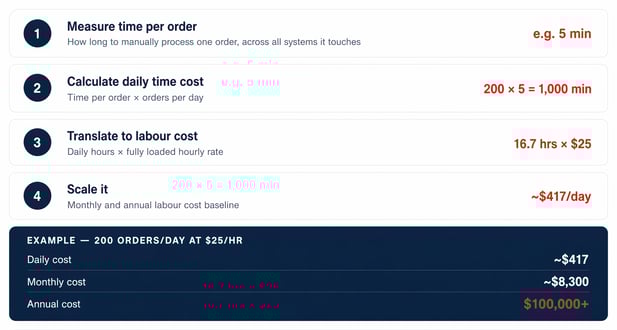
If 4% of 900 monthly EDI orders need 45 minutes of correction once they've posted, that's 27 hours of rework a month. At a fully loaded $30 an hour, roughly $9,700 a year in labour alone, before chargebacks, margin given away on a wrong price, credit notes, re-invoicing, or the customer's patience.
Correcting a posted transaction also means unwinding records that fulfillment and finance may have already acted on.
When you need an order management layer
Not every supplier does.
One EDI trading partner, a stable price list, straightforward orders, and someone reviewing each one before it's keyed: that combination works. At that volume the reviewer is the validation layer, and replacing them solves a problem that isn't costing anything yet.
It gets harder to scale when:
- Trading partners have different implementation requirements
- Customers have different pricing, minimums, or units of measure
- Orders arrive through channels other than EDI
- Staff rely on memory to catch exceptions
- Corrections regularly happen after ERP posting
- Order volume grows faster than the order desk
As those conditions compound, manual review becomes the constraint, and the errors it misses surface in the ERP after the fact.
Where OrderEase fits between EDI and your ERP
OrderEase sits between order intake and the ERP.
| Step | What Happens |
| Capture | Orders arrive from EDI, customer portals, ecommerce, sales reps, and email attachments |
| Normalize | Each one is converted into a consistent order structure |
| Validate | Pricing, customer-specific rules, SKU mapping, and trading-partner requirements are checked |
| Sync | Validated orders syncs into ERPs including NetSuite, Sage, Spire, QuickBooks, and Dynamics |
For EDI orders, that means the trading-partner layer and the business layer are checked in the same place, before anything reaches the system of record.
Fence Armor has processed more than 20,200 Home Depot and Lowe's EDI orders through OrderEase since 2022 with no manual re-keying, and a 10-person team runs the entire EDI-to-ship pipeline with no added headcount.
The order count is the visible part. The headcount that didn't grow alongside it is the part that proves the argument.
FAQs
Is EDI a type of ERP?
No. EDI exchanges standardized documents between trading partners. An ERP manages internal financial and operational records. Most suppliers use both.
What's the difference between EDI and order management software?
EDI defines how an order document is structured and transmitted. Order management software decides what happens once it arrives: which rules apply, whether the order is valid, and where it goes next.
Does an EDI 997 mean my order was accepted?
No. A 997 confirms the document was received and passed structural checks. Acceptance is communicated by the 855, based on a decision your own order system makes.
Final thoughts on EDI vs ERP
EDI can tell you an order arrived in the expected format. Your ERP can record it once it's a transaction. Neither answers the question that decides whether the order should exist as written: is it right?
When that question is left to people, suppliers manage exceptions by hand, one at a time. When it's checked before the ERP, pricing errors and SKU mismatches never become downstream problems at all.
.png?width=250&height=250&name=OrderEase%20logo%2c%20Square%20(2).png)
If EDI orders reach your ERP before anyone has checked the price, the SKU, or the customer's terms, you find out about the errors from your customers. There's a better way.
See how it works
Meet the author