




.png?width=250&name=OrderEase%20logo%2c%20Square%20(2).png)

On this page
Dynamics 365 order management integrations are an operating-model decision. Packaged “accelerators” can be a fast path to value when your channels stay inside the bundle. But most B2B order intake does not.
OrderEase functions as the commerce enablement layer that keeps orders unified across modern channels and traditional intake, so Dynamics 365 remains authoritative and integration ROI shows up in cost-to-serve, speed, and scalable capacity.
Executives often look for ways to reduce exceptions, speed up processes, and scale their operations without hiring more staff. Dynamics 365 supports these goals by offering strong governance and reliable accuracy as the main ERP system.
When reviewing ERP systems, teams often see common features like order intake portals, built-in connections, and orchestration tools. It makes sense to wonder if you really need more solutions when these are already in place.
Most leaders understand that just having integrations does not mean everything will run smoothly. Sometimes, even connected workflows do not match how the business actually sells, fulfills orders, or handles changes.
Many ERP systems come with tools designed for typical ordering situations. If your sales channels fit these setups, things work well. But issues can appear when your business needs go beyond these standard options.
Most B2B companies do not rely on just one storefront, one EDI provider, or a single way to fulfill orders. Orders can come from sales reps, email attachments, spreadsheets, marketplaces, and different commerce platforms. Some companies even use multiple ERPs because of acquisitions, locations, or older systems.
At this stage, integration is about more than just being available. The main question is:
Do your Dynamics 365 order management integrations truly match how you sell today and how you plan to grow in the future?
Your ROI depends on having consistent order intake rules across every channel, not just on how many systems are connected. This helps avoid manual reconciliation.
For a comprehensive overview of how OrderEase supports Microsoft Dynamics 365 across marketplaces, ecommerce platforms, shipping operations, and traditional channels, review Dynamics 365 Order Management Integrations.
The Strategic Option: Bundled Convenience or Future-State Flexibility
ERP vendors often bundle technologies to handle common workflows. These packages make decisions easier, speed up setup, and simplify working with vendors. Many organizations appreciate how this reduces early challenges.
If your channels fit the bundled components, this approach delivers value quickly. The model is simple, handoffs are clear, and exceptions are manageable. The main thing to consider is not just if accelerators work, but if they suit your business model and future goals.
Commerce changes fast. Channels that used to be optional can become important. Marketplaces are able to promote growth, and new regions often need different processes. As companies add more marketplaces, storefronts, or partners, bundled workflows can start to feel limiting.
At this point, many integration strategies fall short. Even with connected systems, operations may become fragmented if business rules differ by channel or provider. Pricing and terms may not match, compliance gets tougher, customer experiences vary, and teams have to step in to fix issues.
To truly align your operations, you need more than just preconfigured tools. You need an order intake model that is able to adapt to changes without adding more manual work.
The Hidden Cost of “Mostly Integrated” Order Intake
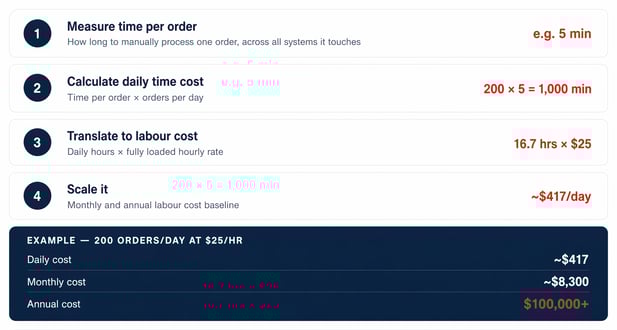
Integration gaps usually do not cause big failures right away. Instead, they slowly drive up operating costs over time. When workflows go beyond what the bundles cover, teams end up re-entering orders, double-checking prices, fixing shipments, and sorting out exceptions later. Every manual step increases the cost per order, slows things down, and hurts data quality.
The cost is more than labor. The bigger issue is operational drag. Small delays add up and reduce throughput and predictability. Inconsistent order intake increases customer service work, warehouse rework, finance corrections, and planning inefficiencies.
That is why a 'mostly integrated' approach can be more troublesome than it seems. It looks automated on the surface, but actually hides manual work that is hard to spot and track.
Poor data quality becomes a financial risk. When the ERP has inconsistent data, leaders lose trust in the numbers. Forecasts become less reliable, inventory decisions get more cautious, and managing exceptions becomes a regular task.
Operational inefficiency often starts before the ERP even processes the order. That is why the return on integration investment is decided earlier in the process.
The Microsoft Dynamics 365 Ecosystem Is Strong, But It Doesn’t Govern Every Order Source
Microsoft Intelligent Order Management (IOM) helps organize orders across multiple systems and partners. This highlights a key point: modern commerce is not about a single system, but about a coordinated ecosystem.
Microsoft also publishes an official provider catalog for Intelligent Order Management. Today, that catalog represents a select set of supported providers, including Orderful for EDI and BigCommerce for ecommerce, along with providers like Avalara (tax and address validation) and ShipStation (shipping management). The list also includes providers such as Flexe and Uber Freight for specific fulfillment and logistics scenarios.
These supported providers are useful for certain situations. However, executives should remember that the catalog only covers a set list of options, not every possible order source or growth path.
A provider catalog moves data between specific systems but does not guarantee that every inbound order follows consistent standards, especially for orders outside supported channels. Many B2B organizations get orders from sales reps, emailed purchase orders, spreadsheet uploads, and marketplaces that do not fit a single channel mix.
This is where you see the difference between simply connecting systems and having a truly unified order intake. As orchestration becomes more complex, having discipline in how you handle intake becomes even more important.
Why ERP and Orchestration Alone Don’t Complete the Commerce Model
Dynamics 365 should stay as your main system of record, keeping governance strong and making sure your financial and operational data stays accurate and reliable.
IOM helps coordinate workflows and manage the complexity for fulfillment. Both of these roles are essential foundations.
However, neither solution is intended to standardize every type of order before it reaches your ERP system.
This is important because order intake can introduce a lot of variability. If you do not manage this, exception rates go up, forecasting becomes less reliable, predictability drops, capacity is limited, and teams spend more time fixing problems instead of growing the business.
Organizations often think these problems mean the ERP needs more integrations or that orchestration needs more providers. In reality, the system is not broken; the intake model just is not complete. The strategic solution is not to add more point solutions, but to implement a single operating layer that governs order entry across all sources.
OrderEase: The Commerce Enablement Layer That Unifies Order Operations
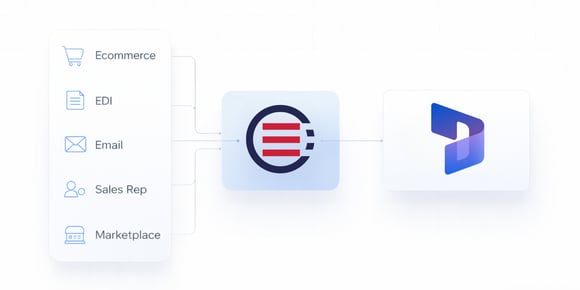
OrderEase is a commerce enablement layer. It complements Dynamics 365 and Microsoft orchestration. Its main role is to standardize and validate order intake before ERP processing. This sustains the system of record accurate and execution repeatable.
Rather than serving a single channel, OrderEase provides a unified intake framework across ecommerce, EDI, sales-rep submitted orders, email and spreadsheet-based orders, marketplace transactions, and multi-ERP environments. This breadth reflects the realities of B2B operations, rather than the limitations of packaged workflows.
OrderEase makes sure business rules are applied the same way every time an order comes in. This means you get complete information, standard order formats, and less cleanup later. As a result, there are fewer errors, less manual work, and cleaner data going into Dynamics 365.
This approach keeps your ERP system reliable and helps orchestration by improving the quality of information used in your processes.
Supporting Multi-Channel Growth
Digital commerce is key to B2B growth. Adding new channels brings more variability, often faster than companies expect.
Each additional channel introduces new risks of incomplete, inconsistent, or non-compliant orders. Marketplaces may differ in product representation, shipping requirements, and order structure. Ecommerce platforms can alter how discounts, taxes, and returns are handled. Fulfillment tools add new handoffs and data dependencies.
If you do not have a unified intake model, adding channels just leads to more exceptions. Sometimes, new development plans end up increasing costs instead of making operations more efficient.
Standardized intake makes it possible to grow at scale. When you use the same rules and order standards across every channel and format, you can add new channels without changing your internal processes. The goal is not to add more integrations, but to make certain everything works consistently.
The objective is not to increase the number of integrations, but to achieve consistent execution across all integrations.
Is the Accelerator Enough?
The accelerator model works well if your channels fit the bundled components, you are not planning to diversify quickly, your order intake is standardized, and you expect your setup to stay the same.
This approach is a good fit if your business works within clear limits and you do not expect much change.
But many companies are not in that situation. You probably need a unified order operations layer if your orders come from marketplaces, emails, sales reps, and different digital channels; if your commerce setup is changing; if you work in different regions or use more than one ERP; or if you plan to grow through acquisitions or new channels.
The defining question is simple:
Will your order intake process look the same in 12 to 24 months?
If the answer is no, a fixed bundle is rarely the best operating model. It may offer an easy start, but it often becomes a costly constraint.
Flexibility for the future is essential. It decides whether your organization can scale efficiently or end up with more operational problems.
ROI Model for Dynamics 365 Order Management Integrations
A unified intake model supports ROI across four key dimensions.
Reduced cost per order
Manual interventions cost more than just labor. They add coordination work from exceptions and clarification cycles. Standardized intake reduces these steps, lowers SG&A per revenue dollar, and boosts throughput without further headcount.
Faster order cycles
Faster order intake means you can process more orders and get revenue sooner. Clean intake lets the following steps start earlier, reduces exceptions, and keeps processes flowing smoothly.
Margin protection
When orders are correct before they reach the ERP, preventable errors go down. This leads to fewer disputes, credits, chargebacks, and rush shipments.
Scalable capacity
You can handle more orders without hiring more people. That is the main promise of a mature order operation.
Operational Visibility Without ERP Disruption
Commerce initiatives fail if they compromise ERP governance. Leadership will not support strategies that create shadow systems or weaken ERP authority. This approach keeps Dynamics 365 as your main system of record, lets orchestration handle fulfillment, and uses intake discipline to cut down on variability before orders reach the ERP.
As exceptions go down, visibility improves. When business rules are consistent, predictability goes up. Your team spends less time fixing data and more time getting things done.
Your integration strategy should give you confidence, not create more uncertainty.
Strengthen the Foundation. Expand with Confidence.
The value of Dynamics 365 order management integrations comes from real results: lower service costs, faster cycles, better data, scalable growth, and strong ERP governance. It is not about how many connections you have.
Keep Dynamics 365 as your main system of record. Use orchestration where it makes sense. Add a commerce enablement layer to bring all your order intake together, even for channels outside the standard bundles.
This way, your integrations will support long-term business performance.
.png?width=250&height=250&name=OrderEase%20logo%2c%20Square%20(2).png)
Strengthen your order operations with a unified intake model that works with Dynamics 365 as the system of record and supports multi-channel growth.
FAQs
For many organizations, Dynamics 365 and Intelligent Order Management can cover a meaningful portion of the order journey, especially when order sources stay within the scenarios Microsoft prioritizes. The challenge is that real B2B order intake rarely stays neatly contained. As channels expand, exceptions multiply, and order formats vary, “Dynamics 365 order management integrations” becomes less about connectivity and more about the operating model you use to control intake at scale.
OrderEase is not positioned as a replacement for Dynamics 365 or IOM. Dynamics 365 remains the ERP system of record for financial governance and operational truth. IOM remains the orchestration layer in Microsoft’s model. OrderEase complements that foundation as an upstream commerce enablement layer that supports B2B order automation, helps reduce manual order entry, and creates a consistent intake standard across multi-channel B2B operations before orders reach the ERP.
When implemented with clear ownership boundaries, a commerce enablement layer strengthens governance. It ensures the ERP system of record receives consistent, governed transactions so Dynamics 365 can enforce control, reporting integrity, and operational truth without becoming the place where exceptions get fixed.
OrderEase supports this by making governance explicit: what data is synchronized, how it is synchronized, and where responsibility lives for the parts of B2B commerce that should not be forced into the ERP. This reduces ambiguity, minimizes rework, and creates cleaner order intake. The result is fewer downstream disputes, more predictable execution, and stronger confidence that Dynamics 365 remains authoritative, even as order sources and channels evolve.
Multi-channel B2B operations almost always increase variability: new formats, new buyer requirements, and new exception types. Without a unified intake standard, each new channel can add revenue and add rework at the same time. The executive risk is that scaling channels turns into scaling exceptions, which raises cost-to-serve and constrains growth.
OrderEase supports multi-channel growth by focusing on governance and consistency at intake. That means creating a repeatable standard for how orders enter the business, regardless of source, so Dynamics 365 can remain stable as the ERP system of record. This also complements IOM’s orchestration role by ensuring downstream orchestration decisions are based on cleaner, more consistent order data. The outcome is channel expansion with less operational disruption and fewer surprises.
Cost reduction comes from eliminating avoidable touches. Margin protection comes from reducing preventable errors that create credits, disputes, and operational waste. In many organizations, these losses do not show up as “integration failures.” They show up as manual rework, longer order cycle times, and inconsistent order data that creates downstream friction across order-to-cash.
The value is created upstream: by standardizing intake and reducing manual order entry, you reduce exception volume, shorten cycle times, and lower the burden on operations and finance teams. Most importantly, you protect Dynamics 365 as the ERP system of record by preventing the ERP from becoming the cleanup layer for channel variability. As volume scales, this model preserves profitability and keeps operational performance predictable.
An accelerator model can be enough when order intake stays within a narrow set of channels and leadership expects that environment to remain stable. The challenge is that most B2B organizations do not stay inside one lane. Channel expansion, acquisitions, customer requirements, and growth initiatives increase variability over time. When that happens, ROI depends less on whether an integration exists and more on whether the business has one consistent standard for what “ERP-ready” means across channels.
Use a simple executive test: will your order intake look materially different 12 to 24 months from now? If yes, a commerce enablement layer becomes a strategic safeguard. It supports B2B order automation, helps reduce manual order entry, and keeps Dynamics 365 protected as the system of record while allowing IOM to focus on orchestration. This model helps ensure that scaling revenue does not require scaling reconciliation work.
Meet the author