




.png?width=250&name=OrderEase%20logo%2c%20Square%20(2).png)


On this page
With a QuickBooks Order Management System, sellers ensure their customers receive the right order at the right time. While QuickBooks can be used for parts of the order process, a proper order management system (OMS), unifies accounting with sales from every channel and every source.
What is QuickBooks Order Management
QuickBooks Order Management refers to the workflows that synchronize orders, inventory and transactions throughout a business. QuickBooks itself is not an OMS, and while it can handle simple operations, it lacks the ability to orchestrate advanced order processing.
What Can QuickBooks Order Management Do?
For some sellers managing simpler order workflows, QuickBooks order management can be handled within the accounting system itself.
Order Capture and Entry
In QuickBooks, sales orders and invoices are input manually from channels, phone, email or PDF purchase orders. With proper workflow knowledge, users can apply customer items, pricing, taxes and payment terms. For businesses with low order volume, this process can remain manageable, but for high-volume operations, accuracy becomes a moving target.
QuickBooks also has a handful of e-commerce integrations that import storefront orders, syncing basic data. Keep in mind that QuickBooks e-commerce integrations treat orders as financial events, not operational records; this leaves teams having to review errors after they've already been ordered by customers.
Fulfillment Workflows
Once orders come in via manual input or e-commerce integrations, QuickBooks can support some fulfillment processes using workflow tools. Using the Sales Order Fulfillment Worksheet or Advanced Inventory (in Enterprise), you can manage shipment preparation from a central dashboard. QuickBooks also allows printing of shipping labels with auto-filled customer and company information right inside the system.
Note - fulfillment only works when orders are consistent and centralized. Without a proper OMS, QuickBooks orders don't follow customized routing or exceptions. QuickBooks merely assumes orders are already structures and ready for fulfillment when they arrive in the system.
Inventory Tracking
QuickBooks can tie some orders to inventory, showing what's in stock and what's on order. On-hand counts are updated with purchase orders, and anything that can't be fulfilled is easily invoiced later. This does rely on a single system view wherein there's no native functionality to normalize inventory as orders come in across multiple sales channels. Inventory lives in QuickBooks but that data relies on the accuracy of each channel.
Invoicing and Financials
After fulfillment, QuickBooks lets you invoice multiple orders on the same invoice for basic billing practices. Orders feed directly into accounts receivable and general ledger, captured as financial transactions. After, orders and inventory are engrained in QuickBooks reporting ecosystem to support operational visibility. Workflow orchestration and channel normalization will still need to be handled by the operations team.
Signs You’ve Outgrown QuickBooks for Order Management
Although many teams rely on QuickBooks to maintain accurate financial records, the problems with order processing will typically worsen as the number of orders and the complexity of those orders increase. Common indicators that an organization's order processing has broken down outside of QuickBooks due to increased volume:
- Multiple sources of orders entering the organization in various formats;
- Manual verification, correction or duplication of orders prior to billing, tracking of order status via shared networks;
- Tracking exceptions and partial shipments through employee knowledge, rather than through a properly functioning order processing system;
- Greater effort from employees to ensure order accuracy as the number of orders increases.
QuickBooks remains an appropriate accounting tool at this stage, but the limitations placed on QuickBooks' ability to act as a governing system for tracking orders through the organization.
Where QuickBooks Falls Short in Order Management
QuickBooks architecture assumes there is only one consistent order path, leaning heavily on accounting logic. As volume and complexity grows, QuickBooks becomes less effective without an order management system to apply workflow logic.
Orders start arriving from multiple sources that have to be manually reviewed or re-entered, inventory discrepancies increase, and operational work moves outside QuickBooks into spreadsheets or inboxes.
Teams often lose visibility into pre-invoice activities like order validation, partial shipments, backorders, or exceptions, relying instead on staff knowledge to manage channel-specific rules.
At this stage, QuickBooks may still produce accurate financial records, but it cannot manage how orders move through the business. Order operations become fragmented, manual, and increasingly difficult to scale.
The Hidden Cost of Relying on Manual Workarounds
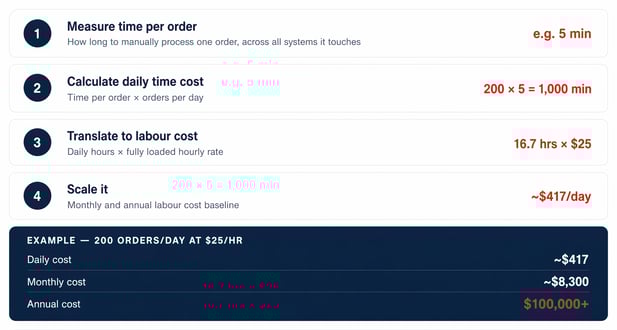
When organizations use QuickBooks way beyond what was meant for it, teams have no choice but to rely on manual efforts to fill in the gaps left by QuickBooks not being able to handle certain processes. After a while, those manual efforts amount to measurable operational costs for the organization.
For example, customer service and operations staff spend 20-40% of their workload doing order entry and correcting orders manually. This is time away from customer service, sales support, and operational improvements.
Even with low error rates, the number of errors creates a compounding effect. Manual data entry into QuickBooks produces a 97-99% accuracy rate. However, just one error can have a downstream effect of creating a mis-shipment, requiring credits, necessitating product returns, or triggering a penalty due to non-compliance with retailer agreements, among others; thus causing work, a lack of satisfaction from customers, and an overall decrease in the profit margin.
Manual processes and therefore erroneous order data slow the fulfillment process. Orders that have to sit in an inbox or spreadsheet before entering QuickBooks will increase the time to process those orders by hours (or days, depending on the number of orders) and increase the likelihood of missing a shipping cutoff date and damaging customer relationships.
As order volume increases, this model introduces the concept of scalability. An increase in volume requires an increase in the number of employees rather than throughput. The costs of increased labor time and increased operational risk is substantial.
Why Patching QuickBooks with Spreadsheets and Plugins are Not Scalable
Many businesses are forced to create intricate systems on top of QuickBooks to deal with the complexities created by the additional work that manual processes create. Therefore, organizations create systems and processes using multiple spreadsheets, point-to-point integrations, or isolated plug-ins in order to patch the holes created by not having the added features available within QuickBooks.
Each of these tools addresses an independent problem; however, the tools do not integrate orders that move through multiple channels. These tools create a fragmented view of orders. In turn, staff have to access various systems to know the location and status of an order.
At a certain threshold, the issue switches from a lack of an added feature to the absence of a centralized governing layer that unifies and coordinates orders before they become financial transactions.
QuickBooks Order Management Applications
For many small-scale operations, QuickBooks offers basic order capture, fulfillment and inventory features but with growth, most businesses will extend it with external tools that automate what the core system cannot handle.
Order Management Systems (OMS)
Order Management Systems acts as the system that governs the entire order lifecycle.
Best for:
Businesses where orders arrive from multiple sources and that need to be validated, standardized, and tracked before they reach QuickBooks.
What an OMS typically handles:
-
Capturing orders from multiple channels
-
Standardizing order data
-
Applying business rules
-
Syncing transactions to QuickBooks
Signs you may need an OMS:
-
You’re using several tools that only solve part of the order flow
-
Orders require review before invoicing
-
Order status lives across systems rather than in one place
An OMS doesn’t replace channel tools, inventory systems, or warehouse software; it orchestrates them. It is the layer that ensures order operations scale without fragmenting.
Ecommerce Sync Platforms
QuickBooks e-commerce integrations work by pulling orders from selling channels/marketplaces, mapping fields, and pushing transactions into QuickBooks.
Best For: Businesses that need order flow from a channel like Shopify or Amazon into QuickBooks
Signs you need this:
-
You’re rekeying orders from your storefront into QuickBooks
-
You deal with mapping errors
Inventory-Centric Order Systems
These systems put inventory logic first, managing availability, backorders and fulfilment.
Best for: Businesses where inventory accuracy and fulfillment matter more than how orders are captured.
Signs you need this:
-
You oversell or discover shortages late
-
You manage multiple warehouses or locations
-
Inventory decisions need to happen before invoicing
Warehouse & Shipping Execution Tools
These platforms optimize pick-pack-ship workflows, syncing shipment and billing data back to QuickBooks.
Best for: Teams with growing fulfillment volume where operational efficiency in the warehouse is the priority.
Signs you need this:
-
Fulfillment errors are frequent or costly
-
Shipping is highly manual
-
Your bottleneck is execution, not order capture
Sales Capture Tools
These tools structure how customers or reps place orders, often with customer-specific pricing, terms, and product rules.
Best for: Businesses receiving orders via POs, email, or reps that need more consistency before orders reach accounting.
Signs you need this:
-
Orders arrive unstructured
-
Pricing varies by customer or contract
-
Sales teams need a controlled way to capture orders
Integration & Automation Layers
These solutions sit between systems, applying rules, transformations, and workflows to move order data.
Best for: Businesses with unique processes that don’t fit neatly into a single tool.
Signs you need this:
-
Every integration requires custom logic
-
Exceptions are common and need visibility
-
You’re coordinating multiple systems around QuickBooks
When Businesses Start Thinking Beyond Extensions
iPaaS and automation options can be extremely effective when the problem is contained to one area of the order flow. Complexity builds gradually across channels, inventory, fulfillment, and billing at the same time. When coordination between these functions becomes the challenge, businesses often begin evaluating a true order management layer to govern the entire process before data reaches accounting.
.png?width=1000&height=300&name=CTA%20(2).png)
How Order Management Stacks Evolve Over Time
Most businesses don’t start with a full order management system. They build their stack incrementally, adding tools as complexity emerges. At first, simple plugins help sellers automate single-channel workflows, ramping up the operational efficiency to eventually implement a proper OMS.
Stage 1: QuickBooks as the Center
At a low order volume, QuickBooks can handle both accounting and basic order workflows. Orders are usually entered manually or come from a single storefront, following a simple, predictable path.
This stage still works if:
-
Orders come from one primary source
-
Manual entry is accurate and sustainable
It’s time to consider the next step if:
-
Order volume is increasing, manual entry is slowing you down
-
New order sources are adding on (e-commerce, POs, marketplaces)
Next logical move: Upgrade QuickBooks (e.g., Enterprise, Advanced Inventory) before adding outside tools.
Stage 2: Extending QuickBooks with Plugins
Once QuickBooks is upgraded, businesses extend it with plugins to sync eCommerce orders, improve inventory accuracy, streamline shipping, or structure order capture.
This stage still works if:
-
Each plugin works to solve a single problem
-
Orders generally flow cleanly
-
Manual work is decreasing
It’s time to consider the next step if:
-
Orders still require review before invoicing
-
Tools must be checked to understand order status
-
Inventory, fulfillment, and accounting are out of sync
Next logical move: Step back and assess coordination, not features.
Stage 3: Coordinating Orders Before Accounting
If manual processes still dominate; the problem is no longer missing functionality. It’s that no system governs how orders move across channels, inventory, fulfillment, and accounting.
Clear signals you’ve reached this point:
-
Orders arrive from multiple sources in different formats
-
Teams validate, route, or fix orders outside QuickBooks
-
Order state lives in spreadsheets, inboxes, or tribal knowledge
Businesses here often begin evaluating a true order management system that's designed to standardize, orchestrate, and govern orders before they become financial transactions in QuickBooks.
The goal isn’t replacing what works. It’s adding a system that removes manual decision-making as complexity grows.
Choosing the Right Path for QuickBooks Order Management
QuickBooks plays a critical role in many growing businesses, and for simpler order workflows, it can effectively support order capture, inventory tracking, fulfillment, and financial reporting. As complexity increases, most teams don’t replace QuickBooks; they extend it.
A true order management system helps by standardizing orders, applying workflow logic, and maintaining a clear order state before transactions reach QuickBooks.
If you’d like to see how OrderEase specifically extends QuickBooks, visit our QuickBooks Order Management. We also invite you to Book A Demo to see the difference a right system can make. Your team and your customers will thank you for it.

Integrate Your Accounting System
Discover QuickBooks Online Integrations. E-commerce, EDI and more.
Meet the author