


Integrate Shopify into your order ecosystem with standardized workflows and no development overhead.



.png?width=300&name=Walmart%20Marketplace%20(1).png)













.png?width=300&name=Walmart%20Marketplace%20(1).png)


.png?width=300&name=Walmart%20Marketplace%20(1).png)


.png?width=300&name=Walmart%20Marketplace%20(1).png)


.png?width=300&name=Walmart%20Marketplace%20(1).png)


How OrderEase Works with Shopify
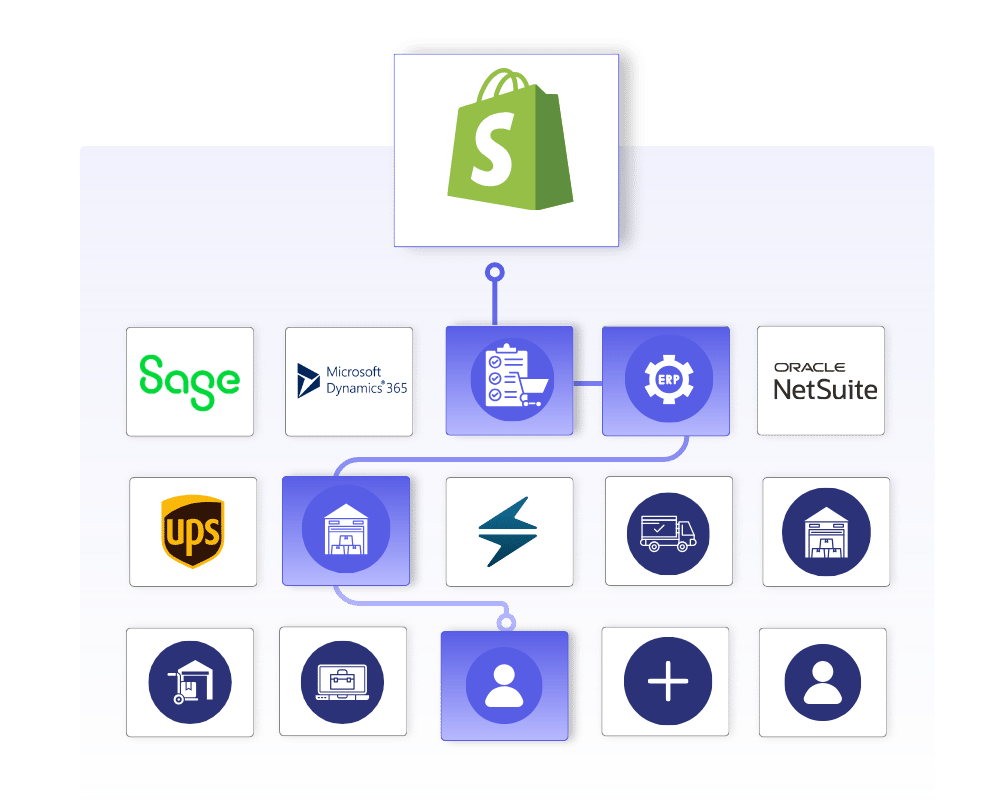
OrderEase connects Shopify into a unified order workflow, syncing products and orders between systems. Orders placed in Shopify, whether retail or wholesale, are captured, enriched with fulfillment logic, and coordinated between inventory sources and ERP systems.
Shopify remains the commerce front end. OrderEase manages the operational complexity behind it by standardizing order data, supporting both B2C and B2B requirements, and ensuring every transaction moves through a consistent, ERP-ready structure.

|
Preconfigured IntegrationsSkip the DIY setup. OrderEase gives you ready-to-use, fully supported Shopify integrations with standardized workflows built in. |
Shopify ↔ OrderEase
Business Impact
What This Means for Shopify Sellers
OrderEase turns Shopify into a structured order engine, not just a storefront. As volume and complexity grow, your operations stay controlled and predictable.
Operational Control
As order volume increases, fulfillment logic, inventory coordination, and ERP handoffs remain consistent. Growth does not translate into internal fire drills.
Fewer Manual Corrections
Orders are structured before they move downstream. Pricing inconsistencies, missing data, and fulfillment mismatches are resolved upstream, reducing cleanup inside ERP and fulfillment systems.
Power Retail and B2B
B2B workflows introduce complexity. OrderEase manages that operational logic outside the storefront, allowing Shopify to stay focused on commerce while B2B requirements are handled in a structured way.
Simplified Expansion
Launching new storefronts, markets, or customer segments does not require rebuilding your operational foundation. Shopify handles the customer experience while OrderEase maintains consistency behind it.
Clean Data Into ERP
Orders flow into ERP systems in a usable, standardized format. Teams spend less time reconciling discrepancies and more time managing growth.
Predictable Performance
Commerce can evolve without destabilizing operations. Variability is managed upstream, so teams can rely on stable workflows and accurate reporting.
Featured Shopify Integrations
Discover More IntegrationsExplore our full integration marketplace and see how OrderEase connects your ERP to the channels, marketplaces, and systems you rely on. |
Shopify Use Cases
Common Shopify Order Management Use Cases
OrderEase extends Shopify with structured operational coordination.
Hybrid B2B and B2C Operations
Retail and wholesale transactions can operate within the same ecosystem while maintaining distinct pricing models, approval flows, and fulfillment paths.
Catalog Synchronization
Product data, pricing updates, and inventory changes remain aligned between Shopify and operational systems to support consistent order handling.
Advanced Segmentation
Wholesale accounts, tiered pricing, customer-specific catalogs, and segmented availability are managed in a structured layer that complements Shopify’s commerce experience.
Multi-Source Order Coordination
Shopify orders are unified with orders from marketplaces, EDI, sales reps, and B2B portals into a single operational workflow.
Frequently Asked Questions About Shopify Integrations
Shopify includes native order management features and for many direct-to-consumer brands, this built-in functionality is sufficient. However, Shopify was not designed to orchestrate complex B2B order workflows, multi-channel sales operations, EDI requirements, or ERP-driven processes. OrderEase extends Shopify by standardizing and orchestrating orders before they move into the rest of your operational ecosystem, acting as a true OMS.
OrderEase automates Shopify orders by capturing them in real time and applying structured validation, pricing logic, inventory checks, and business rules before they move downstream. Instead of relying solely on Shopify’s native workflows, OrderEase standardizes order data and coordinates how it flows across your operational systems.
Yes, Shopify allows bulk order imports using CSV files or third-party apps. However, bulk importing orders is typically a manual process. Instead, OrderEase captures and standardizes orders to ensures required data is complete before orders move into Shopify or downstream systems.
OrderEase connects to Shopify through a prebuilt integration that captures orders in real time and standardizes the data before it moves through your operations. OrderEase manages validation, routing, and orchestration outside the storefront.
Yes. As Shopify orders are created, OrderEase automatically applies business rules. This eliminates manual review, reduces order errors, and ensures Shopify activity is aligned with your operational requirements.
Yes. OrderEase extends Shopify to support structured B2B workflows, including customer-specific pricing, validation rules, inventory controls, and coordinated order routing.
OrderEase can synchronize inventory data and apply location-based availability logic to ensure orders reflect accurate stock levels. This is particularly important for companies managing multi-location inventory or coordinating stock across ERP and warehouse systems.
Yes. OrderEase standardizes Shopify order data and coordinates synchronization with systems. Shopify remains your commerce engine, while OrderEase ensures orders flow across your operational ecosystem.