




.png?width=250&name=OrderEase%20logo%2c%20Square%20(2).png)


On this page
B2B commerce is shifting from a storefront-centric mindset to an operations-led discipline. Modern principles focus on standardizing multi-channel orders, automating upstream validation, and aligning tightly with the ERP.
Today, success depends on order orchestration to enable end-to-end visibility and reduce manual workflows. Instead of just listing products in a digital catalog, modern B2B commerce is evaluated by how reliably they turn any order into a clean, executable workflow. The top B2B eCommerce platforms think about order orchestration, not just entry.
B2B commerce is evolving fast, but not because buyers suddenly discovered online ordering. Gartner research indicates that up to 80% of B2B sales interactions will occur via digital channels by 2025, making digital engagement the dominant mode of buyer interaction and elevating the importance of reliable order processing.
For many sellers, “going digital” started with a storefront or marketplace presence. But the shift is happening behind the scenes: how corporations manage orders across a growing mix of channels has become increasingly complex. The e-commerce portals implemented for B2B are falling short in wholesale use cases and are becoming increasingly disconnected from the rest of the order workflow. The modern approach to commerce accounts for every way orders are placed. Whether it’s a B2B customer ordering portal, retail partners, Amazon, or even emailed POs, forward-thinking leaders are strategizing for the entire ecosystem and how each step can coordinate without manual effort.
What is B2B Commerce?
B2B commerce is any transaction between businesses where a sale of goods takes place. This could be manufacturers selling to distributors, suppliers with products in retailer stores, and brands selling through networks.
In contrast to traditional B2C (business to consumer), B2B buying isn’t just an isolated checkout moment. It’s an ecosystem of negotiated terms, complex rules and nuanced compliance requirements. In B2B, an order is a set of conditions that must be checked, applied, and enforced before the order can be executed. When those rules are handled manually or inconsistently, errors increase, and operations slow down. The businesses that succeed today aren’t simply the ones with the best storefronts. They’re the ones who think about their entire operations.
The Evolution of B2B eCommerce
Historically, B2B commerce relied on phone calls, faxed orders, and emailed POs. Even today, these order entries exist. While these ways of accepting commerce are notoriously slow, they reflect how commerce actually operates.
The first major shift in B2B commerce came with moving order capture online. Digital storefronts reduced the need for physical catalogs, but they also struggled to mirror real-world commerce. Many initiatives still rely on B2C-first commerce tools that provide product discovery and checkout, but force manual workflows for wholesale operations. B2B teams need company customer-specific catalogs, negotiated price lists, net terms, and purchase-order workflows.
E-commerce portals don’t handle that complexity. Even when a supplier launches a proper B2B portal, it rarely replaces the rest of the order ecosystem. Orders still arrive through EDI, retailer portals, marketplaces, sales reps, and emailed purchase orders.
The next phase of B2B commerce isn’t about deciding between online and offline. It’s about choosing whether to manage order complexity intentionally or handle it manually.
Modern B2B organizations are shifting their focus from channel-by-channel optimization to operational consistency. Instead of asking how to make each buying experience better in isolation, they’re investing in systems that standardize orders and connect cleanly to the ERP as the system of record.
In practice, B2B commerce is becoming an order orchestration problem. And the companies that recognize this shift early are the ones building operations that can scale without constant rework.
Transformation in B2B Commerce
Without operational systems that can handle that complexity, growth simply pushes manual work further downstream to ERPs, where team members need to jump in and clean up orders to correspond to your business operations.True digital transformation in B2B commerce starts with how orders are processed, validated, and prepared for execution.
From Order Capture to Order Readiness
Modern B2B organizations still struggle to turn orders into something internal systems can actually use.Here, digital transformation means replacing disconnected workflows with automation. Instead of relying on people to clean up data, check pricing, validate customer rules, or fix errors, modern systems apply those rules automatically.
Customer Experience Dependency on Operations
B2B buyer expectations have risen quickly. Customers expect self-service, fast turnaround times, and fewer errors. Those outcomes are determined by what happens behind the scenes.When order operations are fragmented, even the best front-end experience breaks down. Pricing discrepancies, incorrect shipments, backorders, and delays all diminish trust. Digital transformation is meant to align the buying experience with operational reality, assuring that what customers submit can be fulfilled accurately and on time.
Operational Visibility Becomes a Competitive Advantage
When order data lives across disconnected systems (storefronts, inboxes, spreadsheets, portals), it’s difficult to understand what’s actually happening inside the business.Modern order management systems create a single, structured flow of order data. Instead of reacting to problems after they surface, companies acquire the insight needed to proactively improve processes.Building Adaptability Into B2B OperationsDigital transformation requires an operational system that can absorb change, including new customers, channels, pricing models, and fulfillment requirements. All without constant rework.
Current Trends Shaping B2B Commerce
The trend defining modern B2B commerce is the expanding recognition that scaling sales channels without rethinking order operations creates bottlenecks, errors, and rising costs.
ERP-Centric Thinking
As order volumes grow and complexity rises, businesses are focusing on ERP as the system of record with predictable order flows. Rather than teams manually rekeying orders into ERPs, modern B2B strategies focus on standardizing orders to perfectly match how your system needs to receive them.
Automation Is Moving UpstreamInstead of managing exceptions after they occur, businesses are investing in systems that prevent errors altogether. This includes everything from automated pricing to rule enforcement and order normalization.
Storefront-Led vs Operations-Led Commerce
Some organizations continue on storefronts, layering on integrations and tools to optimize. Others are taking an operations-led approach, prioritizing order standardization and cross-channel visibility first.As B2B commerce matures, the market is increasingly rewarding companies that treat order operations as a strategic capability rather than a back-office concern.
Essential Capabilities of Modern B2B Commerce
Modern B2B commerce depends on how well order complexity is handled once demand increases.As sales channels expand, B2B sellers face a growing set of rules that must be applied consistently across every order. Pricing agreements, product eligibility, payment terms, fulfillment constraints, and compliance become the core of B2B commerce.
Many commerce platforms still treat these requirements as something that should be handled by an add-on tool or an ERP. The result is manual handling that only increases with volume, with teams spending more time correcting orders than selling them.
The most effective B2B commerce solutions take a different approach. They uphold consistency upstream, before orders reach execution systems. Instead of optimizing separate channels in isolation, they establish shared operational logic that applies across all ways customers buy.The capabilities below reflect what modern B2B commerce systems must be able to do to support scale, accuracy, and operational dependability.
Customer-Specific Catalogs and Eligibility
In B2B, there is no single global catalog and buyers expect to see only the products they are eligible to purchase with the prices that reflect negotiated agreements.When catalogs are different across multiple channels, pricing needs to be manually input everywhere.Modern B2B systems centralize catalog rules so product access and pricing remain consistent. You can apply specific pricing to a customer, a group, or a channel. If you’re blending B2B and B2C, perhaps wholesale customers get a discount for bulk purchases, whereas your Amazon sales are priced higher for individual purchases.
Operational Constraints and Compliance Rules
Beyond pricing, B2B orders are governed by operational constraints. These include shipping methods, lead times, fulfillment locations, regulatory requirements, and customer-specific handling rules.A modern B2B commerce solution must consistently apply these constraints before releasing an order for execution. Treating these rules as exceptions instead than defaults leads to delays, errors, and manual handling.Consistency Throughout All Order ChannelsCustomer-specific logic must apply regardless of where an order originates. Whether an order comes from a portal, a sales rep, EDI, a marketplace, or an emailed purchase order, the same rules must be enforced.When logic is embedded in individual channels, consistency breaks down as the number of channels increases. When it is centralized at the order level, personalization becomes reliable and scalable.
Order Orchestration
Order orchestration is the capability that governs how orders move through the business from intake to execution. It is a control layer, often an Order Management System, where business rules are applied consistently, regardless of how or where an order originates.Every order is evaluated, validated, and structured before it is released to downstream systems, such as your ERP or WMS (warehouse management system).
ERP-Centric Integration
In modern B2B commerce tech stacks, the ERP remains the system of record. Orchestration around it makes certain it receives only orders that match your specific business logic.Automated Order ValidationOrder orchestration automates validation at intake. Orders that fail validation are resolved before they create downstream disruption.End-to-End Order VisibilityOrchestration creates a unified view of the order lifecycle across all channels. Because everything is connected, every system and channel are in sync in real time.
Customer Configuration
Modern B2B commerce supports customer-specific pricing, catalogs, workflows, and fulfillment requirements without creating one-off processes. Order orchestration provides a configuration in which rules are applied across channels, allowing the business to adapt as requirements change without rebuilding integrations.
Composable Commerce
Composable commerce indicates a change in how B2B organizations think with respect to flexibility. The goal is no longer to force every sales motion, customer type, and channel into a single buying experience. It is to give teams the ability to choose where and how they sell, without sacrificing operational consistency.
In a B2B context, composable commerce means allowing different channels to serve different purposes. Some customers may order through a self-service portal. Others rely on EDI, sales reps, marketplaces, or retailer-specific systems. These front-end experiences can and should vary based on commercial strategy.
What cannot vary is how orders are processed once they enter the business.
Composable commerce works when flexibility is applied at the channel level, while order execution is governed centrally. Buying experiences can advance independently, but every order should ultimately follow the same operational path. This secures that customer-specific pricing, terms, inventory rules, fulfillment logic, and compliance requirements are applied consistently, regardless of the order's origin.For B2B organizations, this approach is fundamental. Customer requirements change. Channels expand. New partners impose new rules. A rigid, monolithic commerce platform makes these changes expensive and slow. A composable approach lets teams adapt how orders are captured without reworking key operations each time.
However, composability alone is not enough.
Without a central system to govern order logic, composable architectures frequently distribute responsibility across tools. This is where order orchestration becomes the defining capability.
Order orchestration provides the operational backbone that makes composable commerce viable. It’s a connective layer where business rules are applied, and the order state is unified across your ecosystem.
In an orchestrated, composable architecture, storefronts focus on experience, integrations focus on connectivity, and the ERP remains the system of record. Orchestration governs how orders move between them.
Leading B2B Commerce Platforms and Providers
Once the core capabilities are clear, the conversation shifts from features to fit.Each B2B commerce platform is built around a different assumption about where complexity should live:
- Some solutions are optimized for storefront-led selling, valuing speed to launch and buying experience.
- Others focus on sales teams, marketplaces, or partner-driven order capture.
- Still others are built around modular, composable architectures that grant flexibility but require sound operational coordination to succeed.
Smaller operations may succeed with commerce platforms that emphasize front-end experience and basic B2B features. However, as channel mix and customer-specific rules increase, operational demands shift.
OrderEase
OrderEase is an order orchestration–centric platform built to automate intake to fulfillment. It acts as an operational control layer, ensuring every order is validated and ERP-ready.
Who it’s for: Sellers managing multi-channel orders with a requirement for a b2b customer ordering portal.
Considerations: Not a DTC-first storefront or a lightweight plug-and-play eCommerce tool. Best suited for organizations that need orchestration at the core.
Shopify Plus
Shopify Plus is an e-commerce storefront known for usability and a large ecosystem of apps.
Who it’s for: Teams prioritizing hybrid DTC + wholesale.
Considerations: B2B requirements regularly depend on custom integrations.
NuORDER
NuORDER is a B2B wholesale commerce platform for brands and buyers.
Who it’s for: Brands managing buyer relationships, primarily in retail/fashion.
Considerations: Primarily focused on order capture and marketplace workflows; limited control over order orchestration.
Pepperi
Pepperi is a B2B sales platform with basic order management capabilities.
Who it’s for: Wholesale businesses with field sales teams that need mobile order-taking alongside a digital catalog experience.
Considerations: Order management and ERP integration depth can be limited for businesses with complex multi-channel or high-volume operational requirements.
Elastic Path
Elastic Path is a commerce platform that lets businesses to build custom commerce experiences using APIs.
Who it’s for: Enterprises with strong internal development teams looking for control over their architecture.
Considerations: Requires considerable technical resources to be custom-built rather than configured out of the box.
BigCommerce (B2B Edition)
BigCommerce is a SaaS eCommerce platform with growing support for B2B features.
Who it’s for: Mid-market businesses looking for a storefront-led experience with faster deployment.
Considerations: Primarily commerce-led, requiring integrations to manage order workflows.
OroCommerce
OroCommerce is a platform built for complex B2B selling scenarios.
Who it’s for: B2B organizations with workflows that require deep customization.
Considerations: Implementation and maintenance can be resource-intensive, and integrations require extra resources.
Salesforce Commerce Cloud
Salesforce Commerce Cloud is an enterprise commerce platform known for customization.
Who it’s for: Large organizations that want enterprise-grade commerce and already use Salesforce.
Considerations:Implementation and ongoing ownership can be resource-demanding when customized to complex B2B workflows.
Case Study: Success Stories in B2B Commerce Transformation
Real-world examples that illustrate how modernizing order operations can transform business performance.
Muskoka Brewery

A well-known Ontario craft brewery was spending hours each day manually processing orders, rekeying data between systems and managing complex retail and logistics workflows. After implementing OrderEase, the team eliminated manual entry, reduced errors, and freed up staff time to focus on growth and strategy rather than admin work.
Impact highlights:
- Significant reduction in daily manual processing effort
- Fewer errors and smoother coordination with fulfillment partners
- More time to concentrate on strategic business priorities
Implementation: First Steps Toward Operations-Led B2B Commerce
Transitioning from storefront-led to operations-led commerce does not require a new commerce stack. The most successful transformations start by changing where complexity is handled.
1. Start by Mapping How Orders Actually Enter the Business
The first step is to identify where you sell and where manual involvement occurs. Whichever orders require the most intervention become your starting point.
2. Shift Focus from Order Capture to Order Readiness
Early progress comes from standardizing what an acceptable order looks like. How should it show up in your ERP?
3. Introduce Automation Where Exceptions Are Most Costly
Rather than automating everything at once, concentrate on validating the order intake process. Preventing mistakes early reduces downstream rework and creates instant operational relief.
4. Preserve the ERP as the System of Record
Early implementation needs to reinforce the ERP’s role as the system of record by assuring it receives clean, predictable inputs. This reduces resistance from internal teams and allows modernization to progress without disrupting core financial and operational processes.
Measuring Operational Achievement in B2B Commerce
Operational achievement in B2B commerce is measured by how effectively systems absorb complexity. The KPIs below focus on order quality, scalability, and execution reliability—signals that indicate whether improvements are lessening manual work and downstream risk.
Order Quality at Intake
Percentage of orders that reach execution systems without manual correctionHow to calculate(Number of orders processed without human involvement ÷ Total orders processed) × 100Goal
The majority of orders being “touchless.”
Manual Touches per Order
Average number of human interventions per orderHow to calculate
Total manual interventions (data entry, pricing fixes, eligibility checks, corrections) ÷ Total ordersGoal
Drive toward zero for standard orders. Manual effort should be reserved for true exceptions, not routine processing.
Order Cycle Time
Time from order submission to execution readiness.How to calculate
Timestamp when the order is submitted minus the timestamp when the order is released to the ERP or fulfillment systemsGoal
Reduce and stabilize cycle time. Variability matters as much as speed—predictable processing enables better planning and customer communication.
Exception Rate by Channel
Percentage of orders requiring exception handling.How to calculate
(Number of orders with exceptions per channel ÷ Total orders per channel) × 100Goal
Reduce overall exception rates.
Pricing and Terms Accuracy
Rate of pricing and terms discrepancies detected after order submissionHow to calculate
(Number of orders requiring pricing or terms correction ÷ Total orders) × 100Goal
Approach zero. Pricing and terms should be validated before orders are accepted.
ERP Error or Rejection Rate
Percentage of orders rejected or errored by the ERPHow to calculate
(Number of ERP order rejections or failed imports ÷ Total orders sent to ERP) × 100Goal
ERP errors should become rare and predictable.
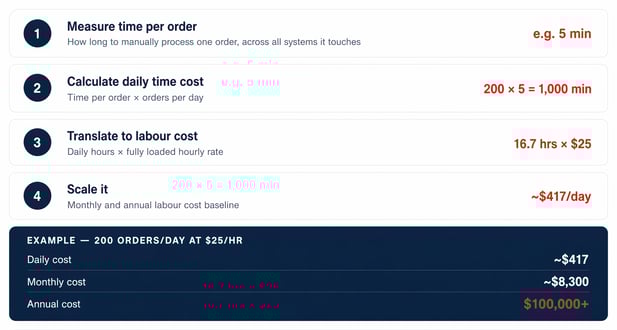
Operational Cost per Order
KPI
Average cost to process an orderHow to calculate
(Total labor costs associated with order ÷ Total orders processed)Goal
Decrease over time, even as order volume increases.
Order Visibility and Aging
Percentage of orders with clear, real-time status and aging insightHow to calculate
(Number of orders with complete status visibility ÷ Total active orders) × 100Goal
Near-total visibility. Teams should be able to detect bottlenecks and stalled orders without manual investigation.
Why These Metrics Matter
Together, these KPIs measure whether complexity is being handled upstream and systematically. When these numbers improve, B2B commerce stops relying on people to fix problems and starts operating as a predictable, scalable system.
Building a Future-Oriented B2B Commerce Strategy
As B2B commerce evolves, many strategies struggle for the same reason: they focus on how orders are sold, not how they’re executed. A future-proof B2B commerce strategy starts by realizing that orders no longer enter the business through a single path. They arrive through eCommerce sites, sales reps, EDI, customer portals, marketplaces, and retailer-specific systems. When each channel is treated as its own workflow, complexity multiplies quickly.
The strategic challenge, then, isn’t customer demand—it’s execution. How does the business take every order, regardless of source, and turn it into something the ERP can process cleanly and consistently?
Streamline B2B Wholesale
Give your customers a faster, more reliable way to order across every channel—while OrderEase keeps pricing, inventory, and orders perfectly in sync in the background.
Meet the author