


<img src="https://certify.alexametrics.com/atrk.gif?account=knr3r1xk/v20jL" style="display:none" height="1" width="1" alt="">
Skip to content
ecommerce integrations

Spire Ecommerce Integration

OrderEase | Xero ecommerce integration
+
Dynamics 365 ecommerce integration
OrderEase connects ecommerce orders to Spire ERP so your team can reduce manual sales order entry, improve order accuracy, and keep online sales aligned with inventory, pricing, and fulfillment operations.
Preconfigured connector · Established integration approach · Hands on support

Shopify - Horizontal Logo Resize
netsuite-logo-2
woocommerce-logo-color-black-squared
Go Daddy logo
Walmart Canada logo
Amazon logo
Shopify - Horizontal Logo Resize
netsuite-logo-2
woocommerce-logo-color-black-squared
Go Daddy logo
Walmart Canada logo
Amazon logo
Shopify - Horizontal Logo Resize
netsuite-logo-2
woocommerce-logo-color-black-squared
Go Daddy logo
Walmart Canada logo
Amazon logo
Shopify - Horizontal Logo Resize
netsuite-logo-2
woocommerce-logo-color-black-squared
Go Daddy logo
Walmart Canada logo
Amazon logo
Shopify - Horizontal Logo Resize
netsuite-logo-2
woocommerce-logo-color-black-squared
Go Daddy logo
Walmart Canada logo
Amazon logo
Preconfigured Connector

Why ecommerce order entry gets harder in Spire ERP as sales channels grow

Spire ERP handles accounting, inventory, sales, and customer data, but orders from ecommerce, marketplaces, wholesale, email, and EDI often arrive incomplete or inconsistent. Teams spend time re-entering and correcting orders just to get accurate sales data into Spire.
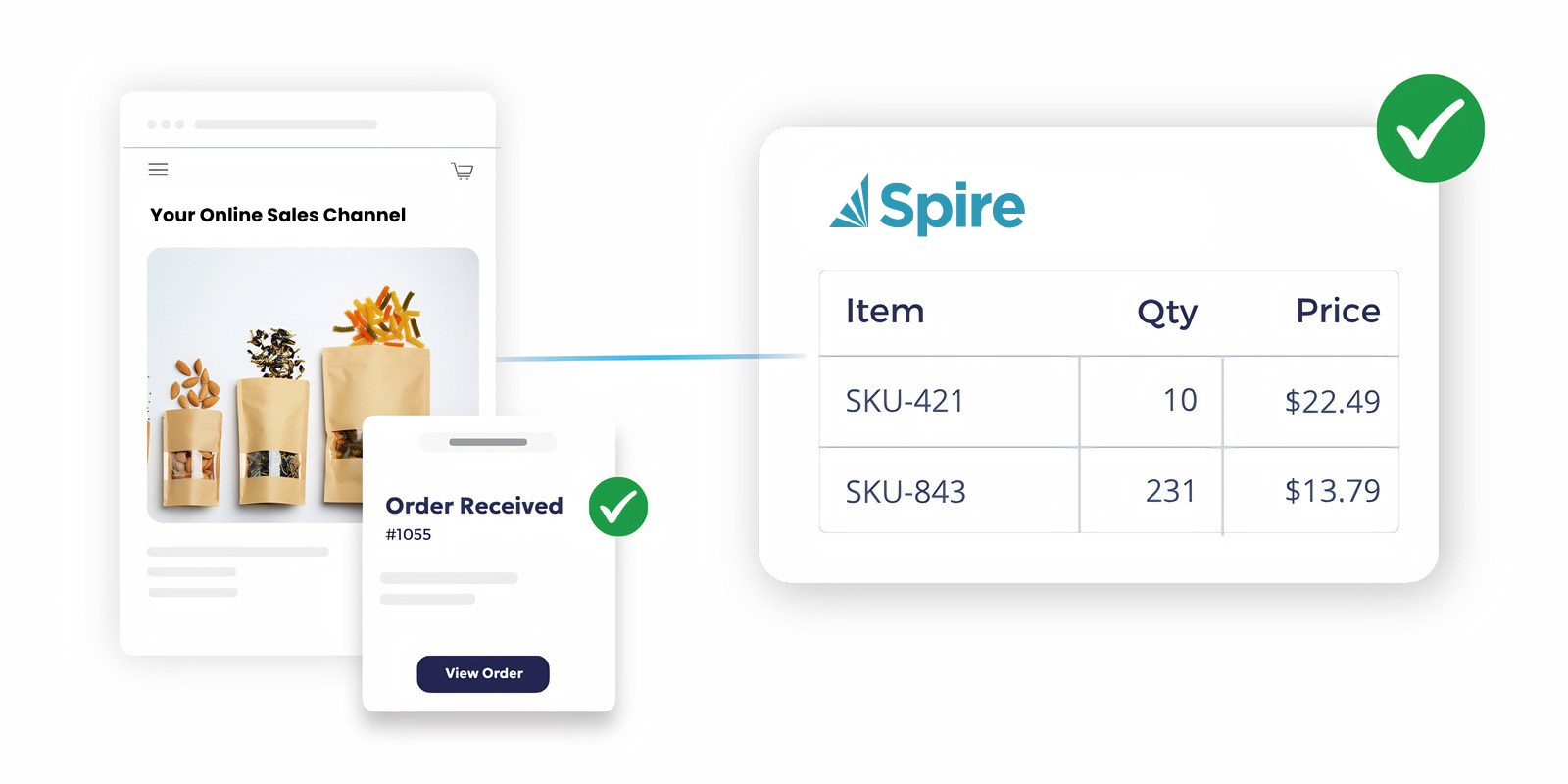
Spire + Ecommerce Integration

Key Features

Spire Ecommerce Integration Capabilities

OrderEase helps Spire ERP users manage incoming ecommerce orders with cleaner sales order data and better control before ERP entry.

Ecommerce Order Capture

Pull orders from online stores, B2B portals, marketplaces, EDI feeds, and emailed order sources before they are entered into Spire ERP.

Spire Sales Order Integration

Send structured sales order data into Spire ERP in a format that supports your existing order entry process.

Product & Catalog Rules

Support account pricing, payment terms, promotions, and customer-specific selling rules across different channels.

Inventory & Product Accuracy

Keep item data, availability, and product details more consistent before orders are created in ERP.

Marketplace & Wholesale Support

Handle more than one sales model without splitting order entry across separate systems, spreadsheets, and inboxes.

Fulfillment-Ready Orders

Pass cleaner order information into warehouse, shipping, and downstream fulfillment processes connected to Spire ERP.

How OrderEase Connects Ecommerce Orders to Spire ERP

OrderEase | Spire ecommerce integration Spire ecommerce integration
OrderEase connects your ecommerce store, marketplaces, wholesale channels, and other order sources to one intake layer.
Order channels are connected
OrderEase | Spire ecommerce integration Spire ecommerce integration
Incoming orders are imported instead of being manually re-entered from multiple systems.
Orders are captured automatically
OrderEase | Spire ecommerce integration Spire ecommerce integration
Customer records, SKUs, quantities, pricing, and shipping details are organized before ERP entry.
Sales order data is prepared
OrderEase | Spire ecommerce integration Spire ecommerce integration
OrderEase applies pricing logic, customer requirements, and channel rules before sales orders move forward.
Order rules are applied
OrderEase | Spire ecommerce integration Spire ecommerce integration
Approved sales order data is sent into Spire ERP with less cleanup required from operations teams.
Orders move into Spire ERP
OrderEase | Spire ecommerce integration Spire ecommerce integration
Warehouse, shipping, and customer service teams receive better order information so they can process orders with fewer delays.
Fulfillment teams get cleaner input

Business Impact

Why teams use OrderEase with Spire ERP

This integration helps businesses that want cleaner ERP order entry, stronger support for ecommerce growth, and fewer manual steps around incoming orders.

Reduce manual order entry

Cut back on rekeying orders from stores, emails, portals, and marketplaces.

Improve order accuracy

Send more complete customer, item, pricing, and shipping data into Spire ERP.

Support ecommerce and wholesale together

Manage self-service online orders and more complex customer buying requirements in the same process.

Keep pricing and product data more consistent

Reduce mismatches between selling channels and ERP records.

Speed up downstream processing

Give warehouse and support teams cleaner orders to work from.

Keep Spire focused on execution

Use Spire ERP as the system of record while OrderEase manages inbound order handling upstream.

More ecommerce and channel

integrations you may be

interested in

Explore the integrations beyond ecommerce and see how OrderEase connects your channels and systems.

Ecommerce Integration

Connect online orders to a cleaner ERP order entry process.

Spire Integration

Integrate OrderEase with Spire ERP for better sales order processing across channels.

Frequently Asked Questions About Spire Ecommerce Integration

Can OrderEase connect ecommerce orders to Spire ERP?

Yes. OrderEase captures ecommerce orders and sends structured sales order data into Spire ERP through a mapped integration process.

Can this support more than one sales channel?

Yes. OrderEase can support ecommerce stores, marketplaces, B2B portals, EDI transactions, and emailed order sources.

Can OrderEase support customer-specific pricing?

Yes. OrderEase supports pricing rules, account terms, promotions, and customer-specific buying requirements across different order sources.

Can this help with inventory and product data alignment?

Yes. OrderEase helps organize item, pricing, and order details before sales orders are created in Spire ERP.

Does OrderEase replace Spire ERP?

No. Spire ERP remains the ERP and system of record. OrderEase manages incoming order intake before handoff.

What businesses is this best for?

It is a strong fit for manufacturers, distributors, wholesalers, and suppliers that need to manage ecommerce alongside other order sources.

Let's Discuss Your Integration Needs