


Cases, eaches and pallets don't match
Retailers order in cases and often don't write the pack size into the order. Your ERP counts eaches, so someone does the conversion, order by order.
Capture orders from every retailer and distributor. Apply your own item codes, case packs and pricing, and hand your ERP or storefront an order that has already been checked.
A retailer sends a purchase order for 12 cases. Someone opens it, works out how many eaches that is, matches the retailer's item number to your SKU and keys it in. Then the ship notice is due, and the lot numbers, expiration dates and pallet labels sit somewhere else.
Retailers order in cases and often don't write the pack size into the order. Your ERP counts eaches, so someone does the conversion, order by order.
Lot numbers, expiration dates, case dimensions and pallet labels all have to be on the ship notice before the truck arrives, and they don't live in one place.
UNFI and US Foods each identify a product their own way, by their item number, your part number or a case GTIN. Matching them is a spreadsheet one person owns.
The order reaches your ERP already checked, whichever channel it came from. Adding a retailer becomes configuration rather than a new build.
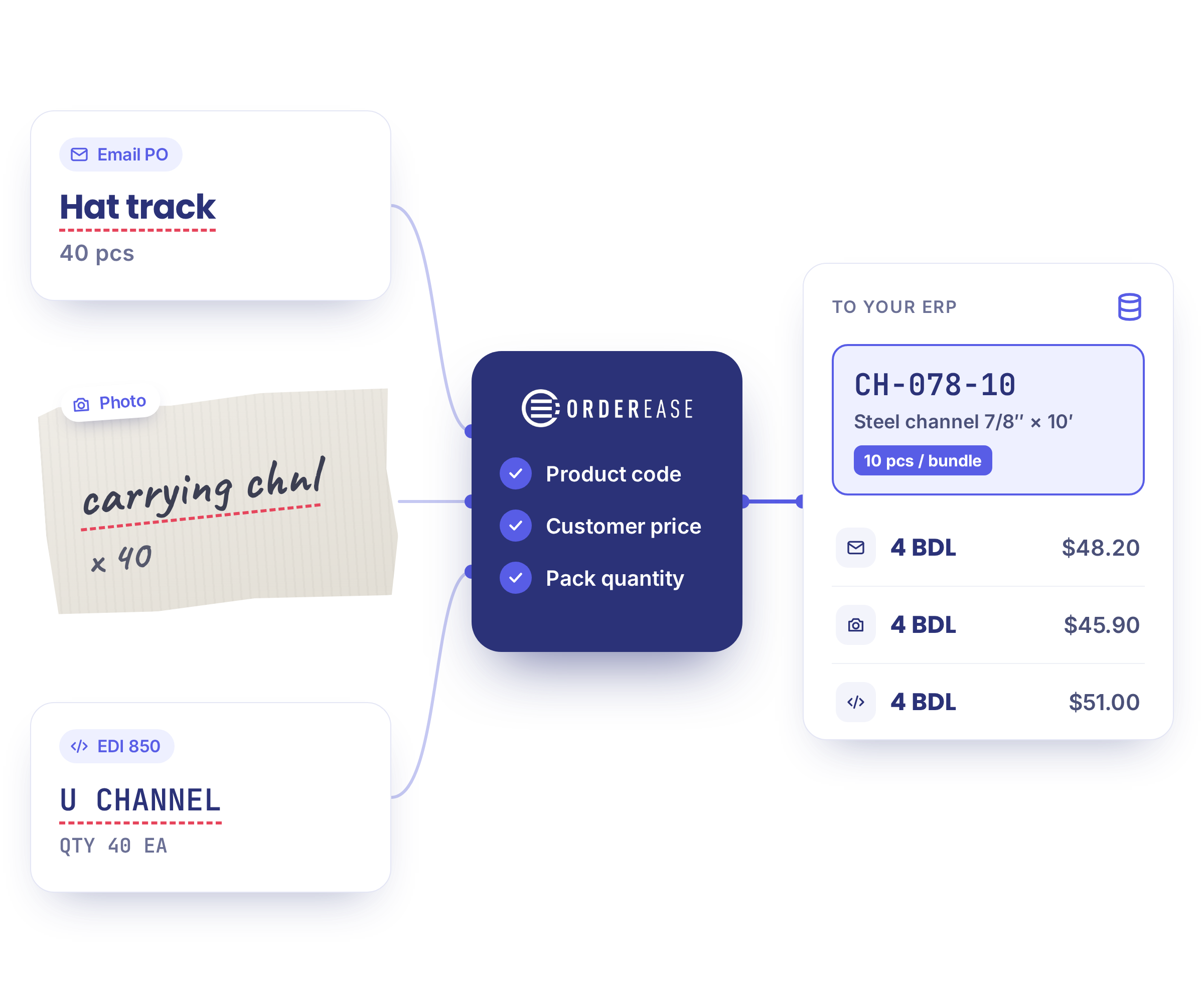
Retailer EDI, emailed POs, your customer portal and your reps all feed the same validated flow. One connection to your ERP, not one per retailer.
Retailer item codes, case conversions and customer pricing run before the order reaches your ERP. Exceptions route to your team instead of into the ERP.
Acknowledgements, ship notices and invoices return in each retailer's required format, with lot and expiration data and pallet labels where the retailer asks for them.
OrderEase creates, formats and transfers the brewery's LCBO orders, so the team no longer enters customer data or sends fulfillment updates by hand.
Read the Muskoka Brewery story→Emailed POs, big-box EDI and portal orders all arrive in different formats. The checks happen once, before any of it reaches your ERP or POS.
Connections depend on your ERP or storefront, version and required data flows. We'll also review item codes, case packs, customer pricing and each retailer's document requirements.
See the retailer and ERP connections we already run →OrderEase supports purchase orders, acknowledgements, ship notices and invoices, including EDI 850, 855, 856 and 810, plus grocery purchase orders (875 and 876) and product activity data (852). Documents, mappings and testing depend on your trading partners.
OrderEase fits when you sell to more than one retailer or distributor, carry retailer-specific item codes and case packs, and the next retailer connection would otherwise mean more manual work. If you receive a handful of orders a month in one consistent format, this is more system than you need.
Show us how a retailer order reaches your ERP or storefront today. Bring a sample PO and we'll walk through where OrderEase could reduce rekeying, apply your rules and connect the handoffs.